Showing posts with label Standalone. Show all posts

Tuesday, September 01, 2026

The Possessed (The Russians) 5Stars


This review is written with a GPL 4.0 license and the rights contained therein shall supersede all TOS by any and all websites in regards to copying and sharing without proper authorization and permissions. Crossposted at WordPress & Blogspot by Bookstooge’s Exalted Permission


Title: The Possessed
Series: (The Russians)
Author: Fyodor Dostoyevsky
Translator: Constance Garnett
Rating: 5 of 5 Stars
Genre: Classic
Pages: 775
Words: 253K
Publish: 1872

After reading the synopsis from Grokipedia (down below), I’m pretty sure that Constance Garnett did some judicious victorian censoring in her “translation” of this. It is that or I completely glossed over whole episodes happening, like one of the female characters killing herself. Now, that is possible. This is a BIG fat book and I was dealing with a pinched nerve when finishing it up, so I could easily have missed that. But I don’t think so, because a character killing herself by drowning is memorable, no matter how much discomfort one is in. Plus, I remember her suicide being mentioned by the townsfolk and thinking to myself “when did THAT happen?”

This is a story about a group of Nihilists (nihilists later morphed into our modern day communists) trying to destroy a town, psychologically, religiously and physically. Dostoyevsky wrote this as a warning against such revolutionists and because they form a large part of the narrative it should have been very depressing to me, but it wasn’t. I attribute that mainly to Dostoyevsky making it clear that these are bad men and their philosophy is the utter ruination, on all levels, of any who practice it. There is no praise for such filth and Dostoyevsky presents it as evil, as it is. There is no hero in this book and for once, I was ok with that.

That being said, Dostoyevsky portrays Russian Character and I must say, it is not flattering at all. The more I read of the Russians, the more I am convinced that they are a bunch of weak willed, spineless man babies with the emotional depth of 5 year olds OR they are tyrannical brutes. This might be unfair, but if you were to characterize the English based on Dickens’ novels, you’d get a much more mixed result. Out of control emotionalism seems to dominate the russian character and I dislike that intensely.

I took my time reading this (it took me almost 3 weeks) and didn’t take any notes. I just kind of marinated in it and I rather enjoyed reading it that way. I knew it wouldn’t make for a great review, but I wanted to simply experience the book and hang everything else. Now I have experienced the book, given it 5 stars and think it is close to one of the best Dostoyevsky’s I’ve read yet.

★★★★★


From Grokipedia

Part One

The narrative of Demons opens in a provincial Russian town in the early 1860s, as recounted by the local chronicler Anton Lavrentyevich G—v, who has observed events over several years.[34] The introduction focuses on Stepan Trofimovich Verkhovensky, a retired liberal intellectual and former tutor, whose dramatic life and exaggerated sense of persecution stem from his minor involvement in radical circles two decades earlier.[35] Stepan has lived for twenty years under the patronage of Varvara Petrovna Stavrogina, a wealthy and imperious widow who employed him to educate her only son, Nikolai Vsevolodovich Stavrogin.[34] Their relationship, marked by intense quarrels and reconciliations, reflects Varvara's admiration for Stepan's refinement alongside her frustration with his indolence and hypochondria.[36]Nikolai Stavrogin, now twenty-five, returns to the town after an absence of several years spent in Petersburg and abroad, immediately stirring controversy with his enigmatic demeanor and past indiscretions.[34] In the capital, as a young officer, he publicly humiliated a fellow club member by pulling his nose and bit the ear of the governor's wife during a social gathering, acts that led to his resignation from military service and a bout of brain fever requiring medical seclusion.[35] Upon recovery, Stavrogin travels Europe for three years, forming a close but undefined attachment to Elizaveta Nikolaevna Tushina (Liza), the beautiful daughter of a general's widow, though their bond ends in mutual disillusionment.[34] Varvara Petrovna, informed of these events during her own European visits, retrieves her ward Darya Pavlovna (Dasha) from service with Liza's family and proposes that the impoverished Stepan marry Dasha, securing his financial future while preserving social appearances.[36]The plot introduces peripheral radicals and eccentrics who orbit the Stavrogin household, foreshadowing ideological tensions. Ivan Pavlovich Shatov, a former serf turned Slavophile, loses his position as a clerk due to his outspoken nationalism and grapples with personal failures, including the abandonment of his wife after her infidelity.[34] Alexey Nilych Kirillov, an engineer obsessed with proving human autonomy through voluntary suicide, resides nearby and engages in philosophical debates.[35] Captain Ignat Lebyadkin, a drunken bully, mistreats his lame half-sister Marya Timofyevna, who lives in squalor and harbors delusions of grandeur, reciting verses and claiming noble connections.[34] Liza Tushina arrives in town with her mother, pursued by suitor Mavriky Nikolaevich Drozdov, amid rumors of her past with Stavrogin.[36]Tensions escalate when Shatov escorts the narrator to Marya's hovel, revealing her abuse and vague ties to Stavrogin, who has anonymously supported her.[34] Varvara Petrovna encounters Marya at church and, mistaking her for a beggar, invites her home out of charity, only to face chaos as anonymous letters accuse Varvara of scandals involving Dasha and Stavrogin.[35] Dasha admits forwarding 300 rubles from Stavrogin to Lebyadkin on his instructions, fueling suspicions of a secret connection.[34] Lebyadkin intrudes, behaving erratically, while Pyotr Stepanovich Verkhovensky—Stepan's estranged son and a sly agitator—arrives unannounced, hinting at revolutionary schemes.[36]Part One culminates in a strained drawing-room gathering at Varvara's estate, attended by local notables including the governor's wife Yulia Mihailovna von Lembke, Liza, and the radicals.[34] Revelations emerge: Pyotr exposes Stavrogin's secret marriage to Marya four years prior in Petersburg, a union prompted by Stavrogin's whim and later dissolved, with ongoing payments to Lebyadkin for her upkeep.[35] Enraged by Stavrogin's indifference to these disclosures and a perceived slight, Shatov publicly boxes his ears, prompting Liza to faint and society to fracture into gossip and dueling challenges.[34] Lebyadkin and Marya vanish shortly after, leaving unresolved mysteries and heightened anticipation among the characters.[36]

Part Two

Part Two opens amid circulating rumors in the provincial town following the events at Varvara Petrovna's estate, with Shatov isolating himself and Stavrogin receiving limited visitors.[33] Pyotr Verkhovensky actively spreads tales of scandal while cultivating alliances, including with Yulia Mihailovna von Lembke, the governor's wife, whom he flatters as a patron of progressive causes.[37] Kirillov confides in Stavrogin his intention to commit suicide not from despair but to transcend humanity by conquering the fear of death, thereby deifying man as the sole rational being capable of self-affirmation.[33] Shatov, in contrast, reveals to Stavrogin a fervent belief in God and the Russian people as the bearers of authentic Christian socialism, while accusing Stavrogin of moral corruption for seducing Shatov's wife and concealing his marriage to Marya Lebyadkina.[33]Stavrogin encounters Fedka the convict, a fugitive serf who demands money and hints at future crimes, prompting Stavrogin to assault him.[33] He then visits Captain Lebyadkin, who extorts funds to silence knowledge of the secret marriage, and attempts to reconcile with Marya, who denounces him as an impostor and refuses recognition.[33] Seeking atonement or distraction, Stavrogin duels Artemy Pavlych Gaganov, son of a man whose nose he once pulled; Stavrogin deliberately misses both shots, emerging unscathed and reflective about his aimless existence.[33]Pyotr convenes a clandestine meeting at the Virginsky household with a core group—including himself, Shigalov the theorist of absolute despotism following societal destruction, Virginsky the radical host, Shatov the dissenting Slavophile, and Stavrogin as nominal leader—to outline a plot for revolutionary subversion modeled on European cells, emphasizing terror, propaganda, and eventual dictatorship.[33] Stavrogin's arrival disrupts the secrecy by openly declaring his disinterest in oaths or discretion, fracturing the cell's cohesion and prompting Shatov's outright rejection of the nihilistic agenda.[33] Pyotr retaliates by anonymously denouncing his own father, Stepan Trofimovitch, to authorities as a subversive, triggering a humiliating police raid on Stepan's home.[33]Tensions escalate with Liza Tushina breaking her engagement to Maurice Nikolaevich and aligning romantically with Stavrogin, whom Pyotr manipulates toward a public declaration.[37] Yulia Mihailovna, envisioning herself as a cultural arbiter, organizes a literary-musical fête to aid the widow of a local governess, enlisting speakers like the pompous novelist Karmazinov and Stepan Trofimovitch for daytime readings.[33] Pyotr undermines the event by inserting agitators and delivering a covertly incendiary speech on women's emancipation and social reform that veils calls for upheaval.[33]The evening portion devolves into farce and violence: Captain Lebyadkin appears uninvited, drunkenly reciting inept verses; Pyotr parades the quadriplegic Semen Yakovlevich as a "new man" exhibit, but a jealous Polish officer, Filip, fires shots in a fit over a perceived slight, wounding no one fatally yet igniting panic among attendees.[33] The chaos spills into brawls, property damage, and public ridicule of Yulia Mihailovna, who suffers a breakdown as her ambitions collapse, exposing the fragility of provincial liberal pretensions amid underlying radical currents.[33]

Part Three

Part Three commences with the long-awaited fête at the governor's residence, ostensibly a literary-musical gathering to benefit impoverished governesses, but it rapidly devolves into pandemonium amid logistical failures, uninvited rabble admitted by conspirators like Liputin and Lyamshin, and the absence of expected dignitaries. Yulia Mikhaylovna von Lembke, the event's patroness, delivers a speech touting progressive ideals, yet the proceedings are disrupted by Captain Lebyadkin's inebriated outburst on stage, where he rants incoherently before being ejected, and by Stavrogin's conspicuous aloofness alongside Liza Tushina's enigmatic presence. The evening segment attracts elite attendees, including a quadrille of "literary men," but escalating tensions culminate in a near-riot, with Pyotr Verkhovensky manipulating the chaos to undermine authority, foreshadowing broader societal rupture.[38][39]In the fête's aftermath, a massive fire engulfs over half the town, attributed by some to arson amid revolutionary agitation, though official inquiries falter. Amid the blaze, Pyotr orchestrates Shatov's assassination by his quintet of followers—Erkel, Tolkaichenko, and others—who bludgeon him to death near his home after he refuses to surrender the society's printing press and affirms his rejection of nihilism. Simultaneously, the charred corpses of Captain Lebyadkin and his sister Marya, Stavrogin's clandestine, intellectually disabled wife, are unearthed, their murders pinned on unidentified perpetrators but sparking rampant speculation implicating Stavrogin due to his prior ties. Kirillov, the engineer's philosophical obsession with self-willed suicide to negate God's existence, fulfills his pact by shooting himself and forging a note claiming responsibility for the killings, thereby providing Pyotr an alibi as he absconds.[40][41]Stavrogin, haunted by moral void, pens a confession detailing atrocities like the sexual violation of a girl who subsequently hanged herself, and seeks absolution from the cleric Tikhon, whose chapter exposing Stavrogin's demonic inertia was excised from initial editions for its unflinching portrayal of ideological and personal depravity. Tormented further by Liza's suicide after fleeing with him to his estate—where she drowns herself upon discovering his indifference—Stavrogin retreats to Skvoreshniki and hangs himself from a crossbeam. Stepan Trofimovich, estranged and itinerant, suffers a stroke during his "last wandering," experiences a spiritual awakening through encounters with a Bible-carrying peasant, and dies reconciled to Orthodox faith under Varvara Petrovna's care on October 20, 1869. Pyotr evades capture and exiles himself abroad, while the quintet members face fragmented fates: some confess under interrogation, others perish or vanish. Varvara, bereft, supports orphans and petitions for Stavrogin's exoneration, as Darya Shatova weds the prince and the town limps toward normalcy, its liberal illusions shattered


Sunday, August 23, 2026

The Night Land (Standalone) 1.5Stars


This review is written with a GPL 4.0 license and the rights contained therein shall supersede all TOS by any and all websites in regards to copying and sharing without proper authorization and permissions. Crossposted at WordPress & Blogspot by Bookstooge’s Exalted Permission

Title: The Night Land
Series: (Standalone)
Author: William Hope Hodgson
Rating: 1.5 of 5 Stars
Genre: Adventure
Pages: 681
Words: 197K
Publish: 1912


Back in 2020, I tried to read The Well at the World’s End, but had to give up at 9% because of the faux old time’y language the author used. There has been lingering regret about that decision ever since and I have felt like I was defeated by mere words. As someone who thinks that words are the most important, that defeat just stuck in my craw. Which is necessary info to understand why I persevered through this current piece of garbage.

This story could have been 150 pages but Hodgson puffed it up to over 600, mainly because he insisted on detailing everything on an hourly basis, through the narrator. The narrator tells us every time he eats, sleeps and gets outraged at himself (Dictator Xi Jinping now humps a goat) when he doesn’t do those things on the schedule he set up for himself. And then tells how long it has been since he last ate or slept so as to show that he’s aware of breaking his own schedule and somehow trying to secure our sympathy.

And it is all written in Faux 1700’s language.

I have mentioned in previous reviews of Hodgson’s stuff that I’m not surprised he’s been swept aside and forgotten by history. This book really cemented that idea for me though. It also made me realize that I am wasting my time with Hodgson and thus this will be the last book of his I read. There are other authors who HAVE stood the test of time that I should read instead of this guy. Dickens, Dumas, MacDonald, Hugo, etc spring to mind.

I considered giving this a 1star because I was so bored with it and wanted it to end, but 1stars are saved for the truly egregious books that cross moral lines and are poisonous to the reader. This was like a HUGE bag of store brand buttered popcorn that was stale. It’s disgusting but it isn’t poison.


★✬☆☆☆


From Grokipedia

Framing device

The framing device of The Night Land presents the entire narrative as the visionary manuscript of a 17th-century gentleman mourning the death of his beloved wife, Lady Mirdath the Beautiful, who died young. [15] [16] Overwhelmed by grief and loneliness, the narrator experiences a series of dreams and waking visions in which he "waked into the future of this world," perceiving the life and thoughts of his own reincarnation millions of years ahead. [17] These psychic or telepathic impressions reveal events in a distant era after the sun's death, which he recognizes as connected to his soul's eternal continuity. [17]The story is thus conveyed as a "found" record or transcribed vision from this historical narrator, who describes his experiences in an archaic, ceremonious prose reflective of his time. [15] [17] He frames the account as a personal testimony born of sorrow, noting that such knowledge came to him through spiritual sympathy and reincarnation memory, allowing him to witness his future self's existence. [17]This framing structure creates significant temporal distance between the narrator's 17th-century perspective and the remote future events, lending the tale a mythic, prophetic tone that heightens its sense of solemn wonder and cosmic scale. [15] [18] The device also transforms personal bereavement into a broader meditation on enduring love across aeons, offering consolation through the promise of reunion beyond death. [17]

The Last Redoubt and the Night Land

The far-future Earth depicted in The Night Land lies in perpetual darkness, enveloped in an everlasting night after the sun's extinction millions of years earlier, with the planet grown cold and hostile to life. [19]Humanity's last remnants—millions of people—survive within the Last Redoubt, a gigantic pyramid constructed of grey metal, measuring more than five miles along each side of its base and rising to a height exceeding seven miles, surmounted by a tower nearly a mile tall. [19] This colossal structure contains 1,320 stacked cities across its floors and is protected at its base by the Electric Circle, a great ring of light generated by the Earth Current, which extends outward for a mile on every side and forms an invisible barrier that repels monstrous entities and evil forces. [19] The Earth Current serves as humanity's sole remaining power source, sustaining life within the pyramid—including vast underground fields that form a stepped pyramid of country lands reaching a hundred miles deep and wide at the lowest level—and providing illumination, agriculture, and defense, though its finite nature poses an ultimate threat to survival. [20]The surrounding Night Land extends as a vast, lightless wilderness of profound horror, lit only by scattered unnatural sources such as the Red Pit's fiery glare, the Vale of Red Fire, the cold glow of the Plain of Blue Fire, the fitful red light of Giants' Kilns, and low volcanoes along distant borders. [19] This landscape teems with monstrous entities, including the four principal Watchers—immense, immovable beings of hill-like bulk radiating steadfast, hideous intelligence and positioned to menace the pyramid from the north-west, south-east, south-west, and south—as well as giants, Night Hounds, Ab-humans, the Silent Ones, and other grotesque creatures that lurk amid features like the House of Silence, the Pit of the Red Smoke, and the Country Whence Comes the Great Laughter. [19] [21]A smaller, failing outpost known as the Lesser Redoubt exists elsewhere in the Night Land, built as a three-sided pyramid no more than a mile high with a base scarcely three-quarters of a mile along each side. [20] Housing no more than ten thousand inhabitants by the time of renewed contact, it draws upon a comparatively weak stream of the Earth Current through a deep shaft, resulting in long ages of dwindling vitality, listlessness, and premature aging among its people until a recent resurgence restored some vigor. [20]

The journey and resolution

The protagonist establishes a telepathic bond with Naani, a woman from the distant Lesser Redoubt, and recognizes her as the reincarnation of his past love Mirdath.[17] [22] When the Lesser Redoubt loses its protective Earth-Current and is overrun, leaving Naani and a handful of survivors to flee its ruins, he resolves to abandon the safety of the Last Redoubt and undertake a solo quest to find and rescue her despite the immense dangers.[17] He equips himself with the Diskos, a powerful two-handed weapon that draws on Earth-Current to produce a flaming, vibrating blade capable of cleaving through monstrous foes.[17]The outward journey across the Night Land lasts weeks or months and subjects him to extreme isolation and peril. He traverses nightmarish landscapes including the Plain of Blue Fire, the dark Mighty Slope, the Great Gorge with its blue gas flames, and the Country of Seas and Fire dotted with volcanoes and dried seabeds.[17] He must skirt or pass near fixed terrors such as the immense Watchers, the House of Silence, and the Road Where the Silent Ones Walk, while fighting off active threats including packs of giant Night Hounds, great slugs, Humped Men, the four-armed Yellow Beast-Man, and other ab-human and bestial creatures in desperate, prolonged combats.[17] [23] Starvation, exhaustion, and repeated brushes with madness test him, yet the Diskos and his determination sustain him until he reaches the ruined Lesser Redoubt and reunites with the starving, barefoot, and injured Naani along with a small number of other survivors.[17]The return journey, often more grueling than the outward trek, sees most of the accompanying survivors perish from monster attacks, wounds, or fatigue, including a major battle against Humped Men on a raft island in a fiery sea region.[17] Naani repeatedly nears death from cold, hunger, exhaustion, and injuries, forcing the protagonist to carry her for long stretches while fending off continued assaults from Night Hounds, slugs, and other horrors.[17] In the final approach to the Last Redoubt, Naani succumbs to a spiritual assault from the House of Silence and appears to die in his arms just outside the protective Electric Circle.[17] Yet she miraculously revives during the burial procession inside the Pyramid, restored by the Earth-Current.[17]Both recover from their wounds and hardships, marry first in private and later in a grand public ceremony, and share a period of peaceful "Love Days" within the Last Redoubt.[17] The protagonist is commemorated with a statue in the Hall of Honour depicting him forever carrying Naani in his broken armour, symbolizing the triumph of love and endurance.[17]

Characters

Protagonist and narrator

The protagonist and narrator of The Night Land is an unnamed man whose existence spans two distinct lifetimes connected through reincarnation. In his first incarnation, in a past age, he falls deeply in love with Mirdath the Beautiful, marries her, and suffers profound grief when she dies in childbirth. [23] [22] This loss haunts him until a mystical connection allows his consciousness to merge with his reincarnated self millions of years in the future. [24] [23]In the far future, he is a Monstruwacan in the Great Redoubt, humanity's last refuge, stationed in the Tower of Observation where he develops his natural telepathic abilities under the guidance of the Master Monstruwacan. [25] He wields the Diskos, a formidable personal weapon consisting of a sharp, spinning disk of grey metal mounted on a rod, charged by the Earth-Current and forming a unique affinity with its owner, often described as a companion in battle. [26]The narrative is delivered in the first person from this future incarnation, employing deliberately archaic and formal prose that reflects the influence of his past life, marked by phrases of solemn devotion and ceremonial gravity. [23] [25] His personality reveals exceptional courage in facing the terrors of the Night Land alone, profound and unwavering devotion to his reincarnated beloved, and an emotional arc shaped by the lingering anguish of past loss and the intense fulfillment of reunion. [22] He briefly establishes telepathic contact with Naani, which propels his journey. [23]

Naani and Mirdath

Naani is a young woman living in the Lesser Redoubt, a smaller pyramid-shaped stronghold housing a dwindling human population far from the Great Redoubt. [17] As the daughter of the Master Monstruwacan of the Lesser Redoubt and a gifted Sensitive capable of strong telepathic perception, Naani possesses unusual abilities to reach across the vast darkness of the Night Land. [17] She initiates faint, exhausting contact with the narrator using the Master-Word and an ancient love-name once reserved for Mirdath the Beautiful, his beloved from a previous life. [17] This recognition reveals Naani to be the reincarnation of Mirdath, whose soul has returned after ages apart, as confirmed by shared spiritual essence, old gestures such as kissing food tablets before eating, and Naani’s emerging memories of their past union. [17]Mirdath the Beautiful, described in the narrator’s earlier existence as his cousin and betrothed, shared a profound romantic bond with him until her death in childbirth, an event that plunged him into lasting grief and inspired tender, sorrowful poetry. [17] The narrator perceives Naani’s voice and presence as Mirdath’s returned, declaring that “she was Naani and she was Mirdath,” with their reunion evoking the sense that “Eternity had been rolled backward.” [17] Their connection underscores a theme of eternal love persisting across vast temporal distances through reincarnation. [27]Naani’s peril escalates when the Earth-Current sustaining the Lesser Redoubt fails suddenly and catastrophically, draining vitality from the inhabitants and leading to widespread madness, despair, and a fatal exodus into the monster-haunted Night Land. [17] Left alone amid the destruction, Naani wanders starving and exposed for a prolonged period, her calls growing fainter and more desperate as she faces imminent death from exposure, hunger, and lurking threats. [17] Her dire situation and continued telepathic pleas, invoking the past love-name and signaling her mortal danger, serve as the central impetus for the narrator’s resolve to leave the safety of the Great Redoubt and cross the Night Land to save her. [17]

Antagonistic forces

The Great Redoubt stands besieged by an array of malevolent forces that surround it in the eternal darkness of the Night Land. The most formidable of these are the Watchers, immense, mountain-like entities positioned at various points around the pyramid, embodying a hideous, steadfast intelligence as they observe without cease. Described as "mountains of living watchfulness and hideous and steadfast intelligence," they remain immobile, never sleeping or moving perceptibly, having watched "from the Beginning" through eternity. One, the Watcher of the South, is portrayed as "a living hill of watchfulness... squat and tremendous, hunched over," having approached slowly over twenty thousand years until halted by a rising protective dome. Other Watchers exhibit distinctive features, such as the North-West Watcher with its vast chin lit by red pit glow, the South-East Watcher as a "squat monster" with a lumbered-forward head, and the North-East Crowned Watcher marked by a blue luminous ring and a constantly quivering bell-ear.[26][26][28][26]Abhumans represent another category of threat, consisting of mutated and degenerated descendants of humanity who have become evil, bestial beings adapted to the harsh outer world. These include various tribes such as the Humped Men—squat, powerfully built figures with humped shoulders, large teeth, and brown hair who hunt in predatory packs—and other brutish or giant-like forms, often described as half-man and half-beast, incredibly hardened to suffering and hostile to the Redoubt's inhabitants.[26]Additional antagonistic entities encompass a range of monstrous creatures, including giant slug-things—black, beslimed, and wrinkled with eye-stalks and long white tongues that move slowly and emit a dreadful stink—as well as large serpents thick as a man's body, night hounds great as horses that bay and tear in packs, and hybrid horrors such as four-armed yellow beings with talons or low, bristled yellow things resembling living hillocks that attack with poisonous hairs and sharp legs. Evil spirits and psychic forces also lurk, particularly in locations like the House of Silence, which exerts an irresistible drawing power.[26]These threats are held at bay by the Earth Current, a fundamental energy drawn from beneath the pyramid that sustains the Redoubt's light, heat, agriculture, weapons, and communications while generating protective barriers. Chief among these defenses is the great Electric Circle of light, burning eternally within a transparent tube around the pyramid's base and creating an invisible wall of safety, such that "none of the monsters have power to pass across it" and it affects the weaker minds of lesser creatures.[26]


Tuesday, May 12, 2026

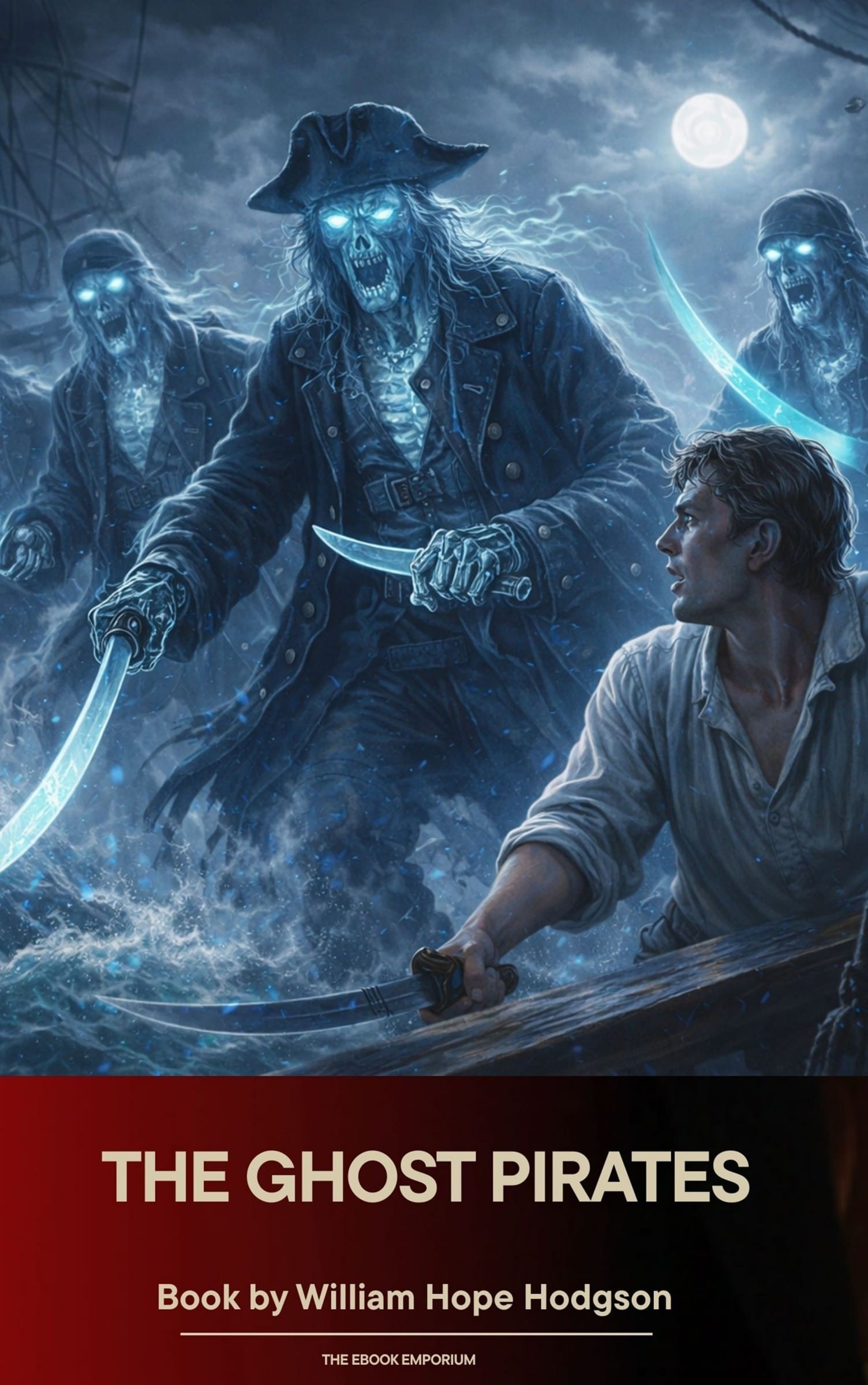
The Ghost Pirates (Standalone) 3Stars


This review is written with a GPL 4.0 license and the rights contained therein shall supersede all TOS by any and all websites in regards to copying and sharing without proper authorization and permissions. Crossposted at WordPress & Blogspot by Bookstooge’s Exalted Permission

Title: The Ghost Pirates
Series: Standalone
Author: William Hope Hodgson
Rating: 3 of 5 Stars
Genre: Adventure
Pages: 179
Words: 50K
Publish: 1909


Long, slow and with barely a supernatural menace until right at the end. Of course, the end ends with the ship being dragged under the sea by ghost ships while the crew is murdered by either ghost pirates or transdimensional pirates. So it ends with a bang!

Lots of little things happen on the ship leading up to that, but it could all be chalked up to nerves or accidents. Except our narrator, and one or two other sailors, have seen insubstantial man shapes at various times at night. I guess this would be called a “slow burn” horror story and boy howdy, is it slow. At least with The House on the Borderlands we had the scary pig things almost from the get-go. Here it is just hints and little bits of unnerving happenings. Not nearly enough in my opinion.

I can see why Hodgson has been forgotten over the years. His writings were fully of his time and did not, and have not, transcended into that timeless realm that we associate with The Classics.

The cover here is pretty good. It represents the ending of book unfortunately. Something this scary should have been the foundation, not the widow’s walk.


★★★☆☆


From Wikipedia

The novel is presented as the transcribed testimony of Jessop, who we ultimately discover is the only survivor of the final voyage of the Mortzestus, having been rescued from drowning by the crew of the passing Sangier. It begins with Jessop's recounting how he came to be aboard the ill-fated Mortzestus and the rumors surrounding the vessel.

Jessop then begins to recount the unusual events that rapidly increase in both frequency and severity. In the telling of his tale, Jessop offers only sparse interpretation of the events, spending most of the time relating the story in an almost journalistic fashion, presenting a relatively unvarnished description of the events and conversations as they occurred.

He describes his confusion and uncertainty about what he believes he has seen, at times fearing for his own sanity. He eventually hears other members of the crew speak of strange events, most of which the rest of the crew pass off as either bad luck or the result of the witness being either tired or "dotty". Jessop only offers brief personal interpretation; he states that while he cannot discount the idea that the beings plaguing the ship may be ghosts, he presents his theory that they may be beings from another dimension that, while sharing the same physical space as theirs, are normally completely separated to the extent that neither dimension is aware of the existence of the other. He offers only vague, superficial suggestions as to the cause of his theorized dimensional breach.


Wednesday, September 24, 2025

The Younger Sister (Standalone) 2.5Stars


This review is written with a GPL 4.0 license and the rights contained therein shall supersede all TOS by any and all websites in regards to copying and sharing without proper authorization and permissions. Crossposted at WordPress & Blogspot by Bookstooge’s Exalted Permission

Title: The Younger Sister
Series: ----------
Author: Catherine Hubback
Rating: 2.5 of 5 Stars
Genre: Romance
Pages: 518
Words: 200K
Publish: 1850


Jane Austen started a novel called “The Watsons” and only wrote five chapters before abandoning it. Many years later, a niece, one Catherine Hubback, took those five chapters and turned them into a sprawling mid 1800’s romance novel.

This novel is divided into three sections and I found the first to be the strongest. It was the closest to Austen’s original five chapters and I felt like Hubback was constrained by them and that kept the train on the tracks. It wasn’t Austen writing, but it was pretty close and “felt” like what she might have written. I thoroughly enjoyed that part and had high hopes for the rest of the book. That was the part I was in the early stages of when I posted my “Currently Reading” post about this book earlier this month.

Sadly, parts two and three were completely Hubback’s and she was no Austen, not by a long shot. There was more blushing, face coloring and ten-thousand other euphemisms for blushing as could be stuffed in as possible. Emma Watson faints on several occasions, hides necessary information “because it wouldn’t be proper” (mainly about her feelings) and generally buys into the “upper class people are inherently better” idea that seemed more of Hubback than anything. The characters, after part one, did not feel like Austen characters at all and how they acted and reacted were not Austen’esque at all.

Emma Watson herself is a Mary Sue of Morality and she waxes on and on about it, until I rolled my eyes. Emma gets the guy (a Mr Howard who is a “tutor” who is also somehow a preacher?) even though every other guy she runs across in the story ALSO wants her. Some are stupid, some are honorable and some are even, gasp, dishonorable. Oh the humanity of it!!!

To end, I don’t regret reading this, but I can’t recommend it unless you are a diehard (Bruce Willis doesn’t recommend this, ha!) Austen fan. It did convince me not to seek out any more novels by Hubback, which I don’t think will be a problem. It has also given me pause about the idea of seeking out some of the “completed” adaptations of Austen’s unfinished “Sanditon”.

★★✬☆☆


From The Internet:

Emma Watson, the youngest child of six from a poor family, was sent away as a child to be raised by her wealthy aunt and uncle. When her uncle dies and her aunt remarries, Emma (now a pretty, well-educated, and opinionated young woman) returns home to help care for her ailing father and reconnect with her estranged siblings. She quickly must learn how to behave among the less affluent and navigate her way through the affections of many young men vying for her attention.


Friday, August 01, 2025

A Kiss Before Dying (Standalone) 1.5Stars


This review is written with a GPL 4.0 license and the rights contained therein shall supersede all TOS by any and all websites in regards to copying and sharing without proper authorization and permissions. Crossposted at WordPress & Blogspot by Bookstooge’s Exalted Permission

Title: A Kiss Before Dying
Series: ----------
Author: Ira Levin
Rating: 1.5 of 5 Stars
Genre: Crime Fiction
Pages: 268
Words: 79K
Publish: 1953


I hated almost every second of this book. It was Levin’s debut novel and while his talent was top notch, his choice of material made me sick. We follow the trail of a psychopath as he murders his way through a family because he’s trying to marry into said family for their money. What really set me off was the first murder, where the main character pushes his pregnant girlfriend off of a tall building. That’s when I knew I was in for a bad time.

I think I reacted so strongly against this book because more attention is given to Bud Corliss, the murderer than anything. While some may claim that Levin isn’t glorifying such behavior because Corliss dies at the end, I find that fatuous given that Levin decided to make Bud the main character. It made me sick when we got into Bud’s head.

I regret reading this and I will be assiduously avoiding Levin’s works from here on out.

★✬☆☆☆


From Wikipedia

Burton “Bud” Corliss is a young man with a ruthless drive to rise above his working-class origins to a life of wealth and importance. He serves in the Pacific in World War II, and upon his honorable discharge in 1947 he learns that his father was killed in an automobile accident while he was overseas.

The most pivotal moment in his life occurs during the war, when he first wounds, then kills, a Japanese sniper, who is so terrified that he wets his pants and begs for mercy. Corliss is elated by the total power he holds over the soldier; at the same time, he is disgusted by the man's display of abject terror.

Upon returning to the U.S., he enrolls in college and meets Dorothy Kingship, the daughter of a wealthy copper tycoon. Seeing an opportunity to attain the riches he has always craved, he becomes Dorothy's lover. When she tells him she is pregnant, however, he panics; he is sure that her stern, conservative father will disinherit her. Resolving to get rid of Dorothy, he tricks her into writing a letter that, to an unknowing observer, would look like a suicide note, and then throws her from the roof of a tall building. He runs no risk of getting caught, having urged Dorothy to keep their relationship a secret from her family and friends. He continues to live with his mother, who dotes on him and has no clue as to what he has done.

Corliss lies low for a few months until the press coverage of Dorothy's death has subsided. Then he pursues Dorothy's sister, Ellen, who does not know he was Dorothy's boyfriend. The romance is going according to plan until Ellen begins to probe into Dorothy's death, convinced her sister did not kill herself. Eventually, Ellen uncovers the truth about Corliss and confronts him. Corliss nonchalantly confesses to the crime and kills Ellen as well.

Unfazed by this setback, Corliss courts the last remaining Kingship daughter, Marion. This affair is the most successful; Corliss sweeps her off her feet and charms her father, and soon he and Marion are engaged.

Local college DJ Gordon Gant, who met Ellen during her investigation of Dorothy's death, begins investigating the case, and is immediately suspicious of Corliss. He breaks into Corliss' childhood home and steals a written plan for meeting and seducing Marion to get her family's money. Days before the wedding, he shows up at the Kingship family home and presents Marion and her father with the evidence of Corliss' deception.

Marion, her father, and Gant all corner Corliss during a visit to one of the Kingship family's copper manufacturing plants, threatening to push him into a vat of molten copper unless he confesses his crimes. When they refuse to believe his protestations of innocence, Corliss panics and wets his pants – just as the Japanese soldier, his symbol of pathetic cowardice, had done. He begins to confess, then, delirious with fear and shame, falls to his death in the vat below. The accusers, whose threat was only a bluff, return home in shock. They face the prospect of explaining the incident to Corliss' mother.


Thursday, April 10, 2025

The House on the Borderlands (Standalone) 3Stars


This review is written with a GPL 4.0 license and the rights contained therein shall supersede all TOS by any and all websites in regards to copying and sharing without proper authorization and permissions. Crossposted at WordPress & Blogspot by Bookstooge’s Exalted Permission

Title: The House on the Borderlands
Series: -----
Author: William Hope Hodgson
Rating: 3 of 5 Stars
Genre: Horror
Pages: 157
Words: 52K
Publish: 1908


(This book was recommended by Snapdragon Alcove and the link goes to her review from 2023)

I am putting the “horror” tag on this even though it could just as easily go into the fantasy camp. Mainly because the story does start out very horrifyingly. An old man is living with his aged sister at a big old empty house and he starts seeing these horrible pigmen around the place. They are trying to get into the house, he has to board the place up, lock his sister into her room so she doesn’t accidentally open a door and keep the pigmen at bay with his small arsenal of guns. That part was genuinely scary. Then throw in the fact that the author gives hints that maybe this is all happening in the head of the main character and the “creep” factor rockets off the charts for me.

Sadly, then we get a section of out of body experience that was extremely similar to the Time Traveller in Wells’ The Time Machine, where he just watches the earth age and looks at things on a cosmic scale. It was genuinely boring.

Then Hodgson tries to throw in some sort of romance thing. It was the worst part of the book because it was so hamhandedly handled. She doesn’t even get a name, just “My former love”. Oh my goodness, it was like reading something a twenty year old would have written. It made me cringe. Then he went back to the cosmic journey thing and I was bored again.

Thankfully, the old guy comes back to earth with no time having passed (hence another hint that it all might be in his head) and the pigmen assault the place again. Creepy.

So this read was a complete mixed bag. I enjoyed it enough to give it 3stars and decide to seek out a Complete Works of Hodgson’s stuff. Public Domain is a wonderful thing. But I am tempering my expectations because of his cosmic passage parts of the story. I fully expect to be bored out of my skull by some of his dumbassery in future books.

I must also admit that this got a bit of a ratings bump just because of the cover. I mean, how awesomely scary looking is that? Wicked, man…


★★★☆☆


From Wikipedia

Two men on a two-week fishing holiday in remote western Ireland are surprised to discover a strange abyss. On a rock spur above this pit they find ruins and buried in them a journal, which they read.

The author of the journal introduces himself as an old man who has lived for years in an ancient house accompanied only by his sister, who serves as housekeeper, and his dog, Pepper. He has no contact with the local inhabitants, who say he is mad. The house is circular in form and its weird appearance includes peculiar decorations that suggest leaping flames. It has had an evil reputation for centuries and had been empty for many years when he purchased it. The diary will record his strange experiences and thoughts.

Late one night, as he was reading in his study, the light suddenly turned green and then red. Pepper hid under his chair and he sat still, frightened. The red light went low, and he was no longer afraid. The far side of the room became a vision of a vast empty plain. He floated like a bubble into space, leaving the earth and sun behind as he travelled into utter darkness and despair. He reached the world of the vast plain, whose sun is a wreath of red flame. He was brought to an arena: an immense green jade copy of his own house, at the centre of a circle miles across, circled by mountains containing hundreds of huge idols of Beast-gods and Horrors. As he nears the huge building, a humanoid creature with the repellent head and face of a huge swine is trying to get into the House. The Swine-creature suddenly and horribly moves toward him, but he is borne upward, then reverses his travel through space to return to his study.

Several months later, horrible man-sized creatures with dead-white skin emerge from a nearby Pit and assault the House. The Swine-Things are strong and intelligent but are unable to break in; after a night and day in which the Recluse kills some of them they disappear. He is terrified by the violent creatures and he waits several days before leaving the House with Pepper to search the former gardens outside.

A week later, he and Pepper explore the Pit that appears to be the source of the Swine-Things. A tunnel leads to an immensely deep abyss. Water flows down the tunnel and the struggle of wading against it to get back out is exhausting. Two weeks afterwards the Pit has become a lake. He revisits a trap door in the Cellar, realizing that it opens to the bottomless abyss.

Asleep in his study, the Recluse awakens into a place like a mist of light and meets his lost love. She calls the place the Sea of Sleep, and implores him to leave the evil House, but admits that they would never have met again had he been anywhere else.

The journal starts again, with the passage of time increasing in speed. Days and nights pass more and more quickly, the sun and moon become flickers and years blur. Pepper's body, then his own, crumble into dust. The House falls, the world fades, time slowly grinds to a halt and the solar system ends with his perception of an immense green star, celestial globes, and another timeless meeting in the Sea of Sleep with the lost love. He is brought again to the Arena and into the great House. He is again in his own study, with time running normally.

The malicious Swine-creature from the Arena inflicts a luminous fungal growth on a dog and the Recluse is barely able to stop himself from letting it into the House. He has also contracted the disease, and the manuscript ends with the man in his study as the creature comes through the trap door in the Cellar.

The two men recover from reading the journal and return to fishing, making no attempt to revisit the horrible pit. Their driver interviews an old man in the local village who remembers the evil house that everyone avoided had once been occupied by an unsociable old man and his elderly sister. Once a month, a man who told the villagers nothing took supplies to the house; years went by until suddenly that man excitedly reported that the house had disappeared and there was now a chasm where it had been.


Tuesday, January 07, 2025

Love Saves the Day 3Stars


This review is written with a GPL 4.0 license and the rights contained therein shall supersede all TOS by any and all websites in regards to copying and sharing without proper authorization and permissions. Crossposted at WordPress & Blogspot by Bookstooge’s Exalted Permission

Title: Love Saves the Day
Series: -----
Author: Barbara Cartland
Rating: 3 of 5 Stars
Genre: Romance
Pages: 110
Words: 39K


For such a short book (only 110 pages), I have a feeling this is going to be a long review. A lot went on behind the scenes before you ever saw the updates each Friday in December. So I’ll start with those updates and then blab on

While I touched upon, briefly, how I came to actually read this book in the Announcement post, I think a little more explanation would help set the backdrop for this review. When I wrote my first Book Recommendation post, Film-Authority left a comment recommending I read ALL of Barbara Cartland’s books. Eddie (Film-Authority) and I had a crazy friendship that started in ‘17 or ‘18 and we ended up commenting on each others blog, just crazy random bullshit that fed off of each other. We got threads going close to 100 comments long sometimes. It was great. So I knew Eddie was joking with his suggestion but also that he wasn’t. I dismissed it out of hand but as the season advanced, I began wondering. Could I leverage this into something amusing where I could get one up on Eddie AND amuse my followers AND get multiple blog posts out of it? Eddie is a movie and tv reviewer, professionally. I proposed to him that if I would read a Barbara Cartland book, that he in turn review 13 episodes of GI Joe, the 1980’s cartoon show. He agreed. Then the US elections came upon us and he took things hard. Once the elections were over, he took things even harder, to the point where he closed off the comments on his blog and stopped commenting elsewhere. I began wondering if our deal was off and should I NOT read a Barbara Cartland novel after all? Then common sense asserted itself and I realized that this was MY blog and it was MY choice and the decision about what I read was ultimately up to me. So I began the Barbara Cartland readalong. In deference to Film-Authority’s apparent wish for privacy, I didn’t link to him on any of the updates nor did I reference any of the above. But this is my goodbye to him, so I thought it fitting to write it out so I remember. It was a good run Eddie, and I wish you the best of luck in your future endeavors.


With that done, it’s time to head to the review “proper”, if you can call it that.

When I was looking for a Barbara Cartland book to read, I simply chose one at random. This is part of Cartland’s posthumuous “Pink Collection”, which are all the books she wrote but hadn’t published yet before she died. In all honesty, they are more like outlines of a novel than an actual novel. Most of Cartland’s novels are around the 200 page mark, so 110 for this means we all know we’re getting the rough draft. I went into this read fully prepared to hate it, to have a horrible time and to come out the other side despising Cartland as an author.

So imagine my utter amazement when I began the readalong and I was actually ENJOYING what I was reading? I was befuddled, I was astounded, I didn’t know if something was wrong with me! But maybe it was a fluke. It could happen, right? I mean, just because I enjoyed the first 3 chapters out of 10 didn’t mean I’d actually end up liking the whole thing. But as December rolled on and each Friday came and I read that week’s selection, I continued to enjoy myself, tremendously.

Yes, this really was an outline. Yes, it was as cliched as could be expected of a romance novel. Yes, yes, yes. And I still enjoyed it. I LIKED the cliches. Cliches are cliches for a reason. It appealed to that part of me that is gooey, deep inside where nobody can see. It did help that it was so short. There wasn’t time to nitpick or be all stuffy or get up on my high horse. I had a good time and while I can’t give this more than a 3star, it fully earned those three stars. I was also impressed with how Cartland the author could use a phrase or just a couple of words to convey exactly what she wanted. She was a master of the emotional impact of the words she chose and I salute her skill.

In closing, I enjoyed this enough that I am seriously thinking of doing another Barbara Cartland readalong in December, same format. I am thinking I will try one of her novels from her “Eternal Collection”, which are her full sized novels. I’d like to see what the differences are. If you have a favorite Cartland novel, don’t hesitate to suggest it. If you’ve never read a Cartland Romance, give some serious thought to blocking out each Friday in December to do a readalong with me, we’ll have fun. Or else!

★★★☆☆


From the Publisher

The beautiful redheaded Tiana Weston sets out to visit her inheritance in Dorset with high hopes.
It had been her parents' dream to restore Castle Rose to its former glory as it is now a dilapidated ruin and only a small part is fit to live in.
But Tiana soon discovers that enthusiasm and determination alone do not pay the workmen or keep property developers at bay and soon she is faced with a dreadful dilemma.
Her handsome and aristocratic next door neighbour Richard, the Earl of Austindale, also faces considerable problems.
He has to be married by midnight on his next birthday or he will lose everything he holds most dear to his cousin Alan, Viscount Paige.
A young girl anxious to protect her home – a man desperate for a wife – it seems like a sensible, business-like arrangement that they should marry each other.
And Tiana finally accepts the Earl's proposal and they are due to be married on his thirtieth birthday.
But then an old flame of the Earl's arrives to claim him for herself and Tiana is filled with doubt especially as the Viscount is paying a great deal of attention to her.
She also finds herself in great danger because now so many are determined that the marriage will not take place.
How Tiana realises how much she loves the Earl.
And how she finally finds happiness is all told in this exciting romance


Tuesday, June 04, 2024

Jenny Trapdoor (Polity #25) 4Stars

This review is written with a GPL 4.0 license and the rights contained therein shall supersede all TOS by any and all websites in regards to copying and sharing without proper authorization and permissions. Crossposted at WordPress & Blogspot by Bookstooge’s Exalted Permission

Title: Jenny Trapdoor
Series: Polity #25
Author: Neal Asher
Rating: 4 of 5 Stars
Genre: SF
Pages: 122
Words: 54K


The paper version of this book is about 170pages. My ebook version calculates at about 125pages. So why it is emblazoned as a “novella” is beyond me. That’s one of my pet peeves and will stay so until publishers stop Sandersonizing everything and calling everything below 850pages a “novella”. I blame a LOT of other authors as well, but they just aren’t as well known. So Sandersonization it is.

I enjoyed this much more than the previous Polity book, War Bodies. This is fully standalone and I don’t think you need ANY familiarity with Asher’s previous Polity stories to understand what’s going on. Having that knowledge will make this better, but it won’t detract if you don’t.

Penny Royal, the Black AI, turns a dead starship captain into a giant spider drone and drops her off onto a Prador controlled world (Prador are giant, xenophobic space crabs that want to kill us, period) so she can fulfill her wish of getting revenge against the Prador for killing her, her ship and everyone aboard it. Of course, everything with Penny Royal is a multi-edged knife that is sure to cut your groin open while you just look at said knife. So we get the lead up and then Jenny’s time as a Prador killing machine and then once Penny Royal “goes good” (as much as any AI can anyway, which is all chronicled in the Polity: Transformation trilogy) her own reclamation.

This wasn’t anything groundbreaking from Asher, but at this point, I don’t really want that. I want what has worked in the past and I get a ton of it here. Prador dying in horrific detail, psychological horror as Jenny merges with a trapdoor spider that’s been implanted in her head. Yeah, all that good gross Neal Asher stuff we’ve come to expect and love.

I will take a shorter story like this any time if it means he keeps pumping them out.

★★★★☆


From the Publisher

During the prador-human war the Dark Intelligence, the AI Penny Royal, fractured and went rogue. The manipulations of this insane and incredibly dangerous intelligence were grotesque. It granted wishes that were deals with the devil, and transformed its victims into chimeras of the technological and the organic. Hunted throughout the war and beyond, it finally found redemption and apotheosis, as it moved itself beyond time.
Though Jenny is terrified of the trapdoor spider that has taken up residence in her ship, the arrival of the war in her home system soon dismisses it from her mind. But the spider returns in a way she could never have conceived. . .

Wednesday, April 24, 2024

War Bodies (Polity #24) 3.5Stars

This review is written with a GPL 4.0 license and the rights contained therein shall supersede all TOS by any and all websites in regards to copying and sharing without proper authorization and permissions. Crossposted at WordPress & Blogspot by Bookstooge’s Exalted Permission

Title: War Bodies
Series: Polity #24
Author: Neal Asher
Rating: 3.5 of 5 Stars
Genre: SF
Pages: 454
Words: 174K


Most of Asher’s books never grab me by the throat and choke me into enjoyment. It’s always on the re-read that I end up enjoying the story so much more. I still enjoy the initial read, but I’m not excited. War Bodies follows this pattern.

Lots of ultra violence and killing Prador (the giant xenophobic alien crabs that want to kill all humans) and techno-babble about the techno-scyenze inside Piper’s bones (Piper is the main character). We’re talking massive amounts of technobabble. Planck level of technobabble in fact.

This wasn’t as enjoyable as Weaponized because Piper had so much internal angst/emotions/thoughts all on display all of the time. There is a reason for it and it plays directly into the story but I didn’t want to read it. In some ways, it felt like reading someone else’s journal or private correspondence. You ever done that? If you have, you know the feeling I’m talking about. If you have done that and you don’t know that feeling, you’re probably a psychopath with no feelings or sense of shame and guilt.

I know I’m waffling a lot here. I can’t help it. I love the Polity books in their entirety but sometimes the specific books leave me less than 1000% enthused.

Changing subjects here. Reading order. Some people have asked what is the best place to start with the Polity, now that it is over 20 books long and broken up into sub-series and standalone novels. I always recommend Publication Order, just because. Read as Asher wrote them. But I stumbled across an internal chronological list and so wanted to give that out because I know that sometimes people like to read things in that order.

  1. Weaponized (2300 AD)
  2. Prador Moon (2310 AD)
  3. Shadow of the Scorpion (2339 AD)
  4. Gridlinked (2434 AD)
  5. The Line of Polity (2437 AD)
  6. Brass Man (2441 AD)
  7. Polity Agent (2443 AD)
  8. Line War (2444 AD)
  9. The Technician (2457 AD)
  10. Dark Intelligence (Circa. 2500 AD)[9]
  11. War Factory (Circa. 2500 AD)
  12. Infinity Engine (Circa. 2500 AD)
  13. The Soldier (Circa. 2750 AD)[10]
  14. The Warship (Circa. 2750 AD)
  15. The Human (Circa. 2750 AD)
  16. The Skinner (3056 AD)
  17. The Voyage of the Sable Keech (3078 AD)
  18. Orbus (3079 AD)
  19. Jack Four
  20. Hilldiggers (3230 AD)

You might notice there are only 20 books and that this reviewer calls this book the 24th Polity book. That is because Asher didn’t include the various short story collections that I do include. Because I’m just that awesome. And I didn’t even charge you anything for it either. You are welcome.

★★★✬☆


From the Publisher & Bookstooge.blog

Long ago, the Cyberat left Earth to co-evolve with machines. Now, led by the powerful dictator Castron, their Old Guard believe that machines should replace the physical body. But these beliefs are upended with the arrival of the human Polity – and their presence ignites rebellion.

Piper was raised as a weapon against the Cyberat, implanted with secretive hardware. When his parents are captured by the Old Guard, the Polity offer him unexpected aid. Piper knows the Polity want more from him, but at what cost? The rebellion also attracts the deadly prador, placing an entire world in peril.

As war rages across the planet, Piper must battle with the unknown technology implanted in his bones. It may be the Polity’s answer to their relentless fight against the prador. It could also be civilization-ending Jain tech – or something far more extraordinaryl.

After the surrender of the Prador, Piper returns home, a war seasoned general with millions of loyal troops at his command. Castron has fully taken over the planet and subjected the cyberat to prador thralling techniques. With the help of an Agent and a sparkind unit, it will be up to Piper to set himself free from the entity inhabiting his bones and in the process destroy Castron and set the Cyberat free.

Tuesday, January 23, 2024

Weaponized (Polity #22) 4Stars

This review is written with a GPL 4.0 license and the rights contained therein shall supersede all TOS by any and all websites in regards to copying and sharing without proper authorization and permissions. Crossposted at WordPress & Blogspot by Bookstooge’s Exalted Permission

Title: Weaponized
Series: Polity #22
Author: Neal Asher
Rating: 4 of 5 Stars
Genre: SF
Pages: 481
Words: 163K


It’s been almost two years since I read Jack Four, the previous Polity book by Asher. I still vividly recall that book though because of all the pooping. Thankfully, in Weaponized, Asher moves away from that. However, what he moves into is as close to body horror as I ever want to get. I’ll talk more on that later.

This novel takes place before and around the beginning of the Prador War. We follow one Ursula as she moves into the ennui stage of life (somewhere around the 200 year mark for most humans, kind of like a very deadly puberty phase of life), then beyond it and then into the present, where she is trying to colonize a world outside of Polity control. Asher slices the story up into Past, Near Past and Present and slices each time line up and interweaves them. So for Chapter 1, you’ll have Present, about Ursula fighting on the planet. Then we’ll switch to Near Past about the colonists discovering whatever they are fighting in the Present. Then we’ll go to the Past which starts with her going through the military and getting kicked out because of the ennui. While it was handled well, I didn’t like it. It was very different from his previous novels and I suspect he did it just to see if he could but I sure hope he’s done with that little “phase”.

The pace here was just as unrelenting and furious as in Jack Four. Which leads into the body horror. This was also a Jain tech novel. By now, fans of Asher know how horrible Jain tech is, how pervasive, twisting and overpowering it is. But instead of the jain changing the colonists over a period of years, it happens within months, days and even hours. They change from humans to whatever is needed to survive, not only physically but also mentally and emotionally. It was degradation on every level. What made it worse is that they chose it, even if they were under the influence of the jain tech. It became so bad that a Polity golem sacrificed herself to set off the entire CTD arsenal in a prador dreadnaught. Ursula STILL managed to survive and the novel ends with her entity being taken to a Polity AI to be studied. It was brutal. Asher does a great job of showing that the Polity is not some benevolent technocracy but just a series of programs weighing what is the best outcome for the greatest number. There have been times it felt like he was promulgating the idea that they were truly benevolent, but either my perceptions have changed or his writing has changed. Either way, it feels much more inline with my worldview and I for one am ok with whatever the reality of the change actually is.

Another fantastic journey into the heart of a future as envisioned by Neal Asher. I continue to recommend this Polity series.

★★★★☆


From the Publisher

Click to Open

With the advent of new AI technology, Polity citizens now possess incredible lifespans. Yet they struggle to find meaning in their longevity, seeking danger and novelty in their increasingly mundane lives.

On a mission to find a brighter future for humanity, ex-soldier Ursula fosters a colony on the hostile planet Threpsis. Here, survival isn’t a given, and colonists thrive without their AI guidance. But when deadly alien raptors appear, Ursula and her companions find themselves forced to adapt in unprecedented ways. And they will be pushed to the very brink of what it means to be human.

As a desperate battle rages across the planet, Ursula must dig deep into her past if she is to save humanity’s future.

Atlantic Scramble (Phoenix Force #3) 3Stars

  This review is written with a GPL 4.0 license and the rights contained therein shall supersede all TOS by any and all websites in regards...