Friday, November 14, 2025

Tower of Silence (Saga of the Forgotten Warrior #4) 4Stars


This review is written with a GPL 4.0 license and the rights contained therein shall supersede all TOS by any and all websites in regards to copying and sharing without proper authorization and permissions. Crossposted at WordPress & Blogspot by Bookstooge’s Exalted Permission


Title: Tower of Silence
Series: Saga of the Forgotten Warrior #4
Author: Larry Correia
Rating: 4 of 5 Stars
Genre: Fantasy
Pages: 374
Words: 132K
Publish: 2023


I have realized that at least for this readthrough of this series, none of the books will be getting higher than four stars. Correia is a fun author, a great pulpy author, but he’s no Rex Stout. Seeing Correia write outside his typical urban fantasy gunporn (ie, Monster Hunter International) does tend to show his weaknesses, that is, the characters. They are decent, they are not cardboard, but they are not nearly as real as Nero Wolfe or Archie Goodwin. The thing is, I wonder if I felt the same way about the MHI characters on my first read through of that series?

So I am still enjoying this series, quite a bit. It is furious action coupled with some very interesting world building that is fusing the traditional fantasy with hints of science fiction. The theology, which plays a vital albeit rather non-specific part, still escapes my grasp. I’m hoping by the end of the series that I’ll understand a bit more. Politics are playing just the right amount without becoming annoying at all.

By this point in the series, I’m definitely recommending it.

★★★★☆


From https://upstreamreviews.substack.com/

After the events of DESTROYER OF WORLDS, the casteless rebellion is scattered and the surviving characters have to make do without Ashok in their ranks. Thus we find them each engaged in their own plans as they wage a war for survival against the government.

Grand Inquisitor Omand Vokkan continues to put his plan into motion to eradicate the casteless and the representative government alike, seizing control of everything. We learn in a flashback that the Inquisition has had a demon in captivity for decades, which they harvest for magic and information. The demon will tell Omand the location of a certain “source” in exchange for all of the casteless being killed, as they are the blood descendants of Ramrowan, the ancient god that defeated the demons the last time they attacked the world.

The demon tricks an eager Omand into sending a band of wizards into a trap, where they accidentally activate a sleeping cell of insect-like demons that slaughter and destroy anything living, and are almost impossible to stop. Omand repays this betrayal with a trick of his own, allowing the demon to think that the casteless have been slaughtered, thus learning the location of the “source” that he’s after, north in the jungle. Upon hearing this the demon activates a spell to notify others of his ilk that it’s time to invade Lok again. Omand isn’t quite sure what, but the demons have activated a spell of some kind, and we learn in an epilogue that (perhaps) all freshwater in Lok—even hundreds of miles inland—has been converted to saltwater…

Ashok Vadal wakes up on the Isle of Fortress, imprisoned, half-starved, and on trial. The residents think he’s a false Ramrowan Reborn, something they’ve seen before, and while Ashok doesn’t lay claim to the title, he does perform several feats of superhuman strength that lead them to believe he’s the real deal. He escapes imprisonment and falls in with a local monk, Dondrub, who gives him the rundown of Fortress’s current political and religious divisions. The Isle is rich with technological knowledge but poor in other resources, especially for creating guns, which they’re known for. Dondrub shows Ashok the underground/undersea tunnel that Fortress smugglers use to get to Lok, but it’s occupied by a demon god. Ashok slays this creature and takes its head back to Fortress, deposing another false Ramrowan along the way, although Dondrub dies in the conflict.

With the tunnel cleared, Ashok returns to Lok, just in time to learn that an enemy house has found the casteless rebels and is about to annihilate them. He rushes into battle and finds their champion, a new black steel swordbearer named Akerselem. They duel, and for the first time in his life Ashok is almost equally matched, as Akerselem’s sword gives him the same knowledge and skill that Angruvadal gives to Ashok. In the end Ashok triumphs and cuts off Akerselem’s sword arm, defeating him, and ultimately taking up his sword for himself. Once again Ashok has an ancestor blade.

Keta, Keeper of Names, continues to lead the casteless rebels as their priest, though the situation continues to worsen. He does his best to fend off Akerselem’s forces at the rebels’ hiding place, and while he’s just a man, he dies heroically against a black steel swordbearer, leaving the descendants of Ramrowan without a spiritual guide.

Javed, an Inquisition spy planted among the rebels, has been feeding information about them to Omand. When two young hunters find him communicating with his master, Javed kills them and hides their bodies, though the act shames him and he eventually struggles with his loyalties. At the end he’s visited by Mother Dawn, a traveling demigod who takes the form of witches and other things, to tell him that her loyalists (the rebels) need a Keeper of Names. He is to fill the void that Keta left behind. The rebels know what he did though, so this will be no small hurdle to overcome.

As for the prophetess Thera Vane, she continues to lead the rebellion though she misses having Ashok at her side, and she has to make do with lesser assets. One of her more key discoveries is that the mute and damaged children she rescued from the House of Assassins are actually capable of magic, and are slowly coming back to their senses. She’s able to nurture them back to sanity and they make powerful contributions to the rebels’ efforts, helping to destroy aqueducts that deliver water to their enemies. Near the end she learns that Javed is a traitor, and she sows doubt in him that he’s on the right side. Her part of the story ends when she’s captured and swept away to be put on trial, only to be intercepted by Dhaval Makao, a man she ran away from years ago…who is her legal husband.

Once again, the fates of warrior Jagdish, scholar Rada, and protector Karno are intertwined. Jagdish is now a high-ranking officer in House Vadal, which faces border invasions from Akerselem and his new army. House leader Harta Vadal wants Jagdish to face Akerselem in open combat with the hope that somebody will kill him and Vadal will once again have an ancestor blade. (As a reminder, their sword was Angruvadal, which was lost when Ashok was exiled in book 1, and later shattered.)

Rada, meanwhile, communicates from time to time with the black steel mirror that she carries, gifted to her by her late mentor. While made of the same material as the ancestor blades, it performs differently, opening a communication channel to a powerful entity loyal to the Forgotten Gods. Rada and Karno accompany Jagdish and a detachment of his soldiers on an expedition, only to come across the band of wizards that Omand unknowingly sent into a trap. Several of Jagdish’s soldiers are killed by the demon-insects, which almost overwhelm Karno, and nobody escapes unscathed. Rada appeals to the entity in the mirror, who isn’t overly concerned with the humans and their quest, until Rada explains that saving them means they can be useful to the gods later.

The mirror then summons up a force field around Jagdish, Rada, and the other survivors and fires a superweapon from somewhere unknown, obliterating all of the demon-insects that were trying to kill them.

When they report their findings back to Harta Vadal, he wants to know if this super weapon can be conjured up again and controlled. Rada is more worried about the demon insects and the affairs of the Gods, as things continue to intensify.

Lord Protector Devedas has a diminished role in this story, but he’s not out of it. Riding high on a wave of popular support after defeating Ashok, he only becomes more useful to Omand and his scheming. When the time is right for a perverse act of governmental subversion, Omand calls for all power to be concentrated in Devedas to deal with the rebel crisis, under the condition that Devedas will of course give up his power once the problem is solved.

In conclusion, this story covers a scattered cast of characters who do their best to move toward their group goals even without being able to rely on each other


Thursday, November 13, 2025

The Stone of Farewell (Memory, Sorrow and Thorn #2) 5Stars


This review is written with a GPL 4.0 license and the rights contained therein shall supersede all TOS by any and all websites in regards to copying and sharing without proper authorization and permissions. Crossposted at WordPress & Blogspot by Bookstooge’s Exalted Permission

Title: The Stone of Farewell
Series: Memory, Sorrow and Thorn #2
Author: Tad Williams
Rating: 5 of 5 Stars
Genre: Epic Fantasy
Pages: 727
Words: 268K
Publish: 1990


My fourth chunkster of a book this month and thankfully, NOT a dnf. I couldn’t have dealt with another dnf, I just couldn’t have. Tad Williams was writing massive books 15 years before Sanderson ever hit the scene. You go Tad, youdaman! Plus, this was even better in 2025 than when I read it in 2003 (technically, I read it at least twice before then, I just wasn’t recording my reading before 2000).

Ok, all the miscellaneous stuff is out of my system, time to get down to the nuts and bolts of this review.

I liked this. A lot. In fact, I liked this 5stars worth. Now, for any of you other reviewers out there who indiscriminately hand out fivestars, or even fourstars, like candy, ie, your average rating is 4 or above (and you are a bad reviewer if that is the case because it means you have no discriminating taste. You are a mindless bookivore), let’s put this in perspective. Up to this point, in the entire year of 2025, I have had SIX 5star reads. That is because I have high standards and I’m flipping proud of that. An author has to work to get a 5star from me. I don’t have a gold standard when it comes to books, I have the Bookstooge Standard. And Tad Williams, with The Stone of Farewell, has totally earned that 5star rating from me.

Unlike this month’s earlier The Resolve of Immortal Flesh, the characters in Farewell come across as real people, as fleshed out individuals, not just a set of characteristics with a name tacked on the cardboard they have for a chest. Now, don’t ask me HOW to do that, because I’m not an author, but as a dedicated reader, I can spot the difference a mile away. Even while having 3-4 different storylines going on at the same time, with tons of characters, I was never once tripping over who was who or thinking to myself “ok, who is this person again?” I am coming to realize that when I read a series, or a big book, that characters matter to me. In shorter books, or novellas, the Idea can be enough to carry things along, but in a chunkster of a book in a chunkster of a series, well, Characters Count.


Count Von Count knows that Characters Count!

The next important part is the story itself. Williams takes his time, as he did in the previous book The Dragonbone Chair, to slowly unspool events. I never felt like things were happening deus ex machina. He also balances the various threads in the story just right. We get enough of each story line to fill in what is needed and to set up what we are about to read in another story line. In that balancing act, much like with the characters, I once again never felt lost or confused or had any trouble remembering how the storylines were tying together. It felt like a wonderfully woven tapestry where you could appreciate each thread line or step back and appreciate the whole, as both were done with a deft touch.

Now you know, the talent and skill that Williams displays with this book, and with the whole Memory, Sorrow and Thorn trilogy, isn’t something that happened overnight. He didn’t write up some garbage, release it on Kindle Direct and then claim that he was a published author and then go on to demand that everyone pay him attention because he was “published”. Even talented people need to practice and increase their skill. Williams’ final products showcase this and I for one, as a discriminating reader with taste and standards, appreciate the living daylights out of it. The more so because I didn’t have to wade though his pile of unpublishable garbage. Writers, take note. Keep your crappy garbage in the drawer where it belongs and don’t inflict it on us, we don’t deserve that.

The synopsis below is once again so full that if you read it, you really won’t need to read the book itself if epic fantasy isn’t your bailiwick. It is mine though, so I know at some point I’ll be reading this trilogy again. I can’t think of any higher praise...

★★★★★


From Fandom.com

Simon, the Sitha Jiriki, and soldier Haestan are honored guests in the mountaintop city of the diminutive Qanuc trolls. But Sludig - whose Rimmersgard folk are the Quanuc's ancient enemies - and Simon's troll friend Binabik are not so well treated; Binabik's people hold them both captive, under sentence of death. An audience with the Herder and Huntress, rulers of the Qanuc, reveals that Binabik is being blamed not only for deserting his tribe, but for failing to fulfill his vow of marriage to Sisqi, youngest daughter of the reigning family. Simon begs Jiriki to intercede, but the Sitha has obligations to his own family, and will not in any case interfere with trollish justice. Shortly before the executions, Jiriki departs for this home.

Although Sisqi is bitter about Binabik's seeming fickleness, she cannot stand to see him killed. With Simon and Haestan, she arranges a rescue of the two prisoners but as they seek a scroll from Binabik's master's cave which will give them the information necessary to find a place named the Stone of Farewell - which Simon has learned of in a vision - they are recaptured by the angry Qanuc leaders. But Binabik's master's death-testament confirms the troll's story of his absence, and its warnings finally convince the Herder and the Huntress that there are indeed dangers to all the land which they have not understood. After some discussion, the prisoners are pardoned and Simon and his companions are given permission to leave Yiqanuc and take the powerful sword Thorn to exiled Prince Josua. Sisqi and other trolls will accompany them as far as the base of the mountains.

Meanwhile, Josua and a small band of followers have escaped the destruction of Naglimund and are wandering through the Aldheorte Forest, chased by the Storm King's Norns. They must defend themselves against not only arrows and spears but dark magic, but at last they are met by Geloe, the forest woman, and Leleth, the mute child Simon had rescued from the terrible hounds of Stormspike. The stange pair lead Josua's party through the forest to a place that once belonged to the Sithi, where the Norns dare not pursue them for fear of breaking the ancient Pact between the sundered kin. Geloe then tells them they should travel on to another place even more sacred to the Sithi, the same Stone of Farewell to which she had directed Simon in the vision she sent him.

Miriamele, daughter of High King Elias and niece of Josua, is traveling south in hope of finding allies for Josua among her relatives in the courts of Nabban; she is accompanied by the dissolute monk Cadrach. They are captured by Count Streawe of Perdruin, a cunning and mercenary man, who tells Miriamele he is going to deliver her to an unnamed person to whom he owes a debt. To Miriamele's joy, this mysterious personage turns out to be a friend, the priest Dinivan, who is secretary to Lector Ranessin, the leader of Mother Church. Dinivan is secretly a member of the League of the Scroll, and hopes that Miriamele can convince the lector to denounce Elias and his counselor, the renegade priest Pryrates. Mother Church is under siege, not only from Elias, who demands the church not interfere with him, but from the Fire dancers, religious fanatics who claim the Storm King comes to them in dreams. Ranessin listens to what Miriamele has to say and is very troubled.

Simon and his companions are attacked by snow-giants on their way down from the high mountains, and the soldier Haestan and many trolls are killed. Later, as he broods on the injustice of life and death, Simon inadvertently awakens the Sitha mirror Jiriki had given him as a summoning charm, and travels on the Dream Road to encounter the first the Sitha matriarch Amerasu, then the terrible Norn Queen Utuk'ku. Amerasu is trying to understand the schemes of Utuk'ku and the Storm King, and is traveling the Dream Road in search of both wisdom and allies.

Josua and the remainder of his company at last emerge from the forest onto the grasslands of the High Thrithing, where they are almost immediately captured by the nomadic clan led by March-Thane Fikolmij, who is the father of Josua's lover Vorzheva. Fikolmij begrudges the loss of his daughter, and after beating the prince severly, arranges a duel in which he intends that Josua should be killed; Fikolmij's plan fails and Josua survives. Fikolmij is then forced to pay off a bet by giving the prince's company horses. Josua is strongly affected the shame Vorzheva feels at seeing her people again, marries her in front of Fikolmij and the assembled clan. When Vorzheva's father gleefully announces that soldiers of King Elias are coming across the grasslands to capture them, the prince and his followers ride away east toward the Stone of Farewell.

In far off Hernystir, Maegwin is the last of her line. Her father the king and her brother have both been killed fighting Elias' pawn Skali, and she and her people have taken refuge in caves in the Grianspog Mountains. Maegwin has been troubled by strange dreams, and finds herself drawn into the old mines and caverns beneath the Grianspog. Count Eolair, her father's most trusted liege-man, goes in search of her, and together he and Maegwin enter the great underground city of Mezutu'a. Maegwin is convinced that the Sithi live there, and that they will come to the rescue of the Hernystiri as they did in the old days, but the only inhabitants they discover in the crumbling city are the dwarrows, a strange timid group of delvers distantly related to the immortals. The dwarrows, who are metalwrights as well as stonecrafters, reveal that the sword Minneyar that Josua's people seek is actually the blade known as Bright-Nail, which was buried with Prester John, father of Josua and Elias. This news means little to Maegwin, who is shattered to find that her dreams have brought her people no real assistance. She is also at least as troubled by what she considers her foolish love for Eolair, so she invents an errand for him - taking news of Minneyar and maps of dwarrows' diggings, which include tunnels below Elias' castle, the Hayholt, to Josua and his band of survivors. Eolair is puzzled and angry at being sent away, but goes.

Simon and Binabik and Sludig leave Sisqi and the other trolls at the base of the mountain and continue across the icy vastness of the White Waste. Just at the northern edge of the great forest, they find an old abbey inhabited by children and their caretaker, an older girl named Skodi. They stay the night, glad to be out of the cold, but Skodi proves to be more than she seems: in the darkness she traps three of them by witchcraft, then begins a ceremony in which she intends to invoke the Storm King and show him that she has captured the sword Thorn. One of the undead Red Hand appears because of Skodi's spell, but a child disrupts the ritual and brings up a monstrous swarm of diggers. Skodi and the children are killed, but Simon and the others escape, thanks largely to Binabik's fierce wolf Qantaqa. But Simon is almost mad from the mind-touch of the Red Hand, and rides away from his companions, crashing into a tree at last and striking himself senseless. He falls down a gulley, and Binabi and Sludig are unable to find him. At last, full of remorse, they take the sword Thorn and continue on toward the Stone of Farewell without him.

Several people besides Miriamele and Cadrach have arrived the lector's palace in Nabban. One of them is Josua's ally Duke Isgrimnur, who is searching for Miriamele. Another is Pryrates, who has come to bring Lector Ranessin an ultimatum from the king. The lector angrily denounces both Pryrates and Elias; the king's emissary walks out of the banquet, threatening revenge.

That night, Pryrates metamorphoses himself with a spell he has been given by the Storm King's servitors, and becomes a shadowy thing. He kills Dinivan and then brutally murders the lector. Afterward, he sets the halls aflame to cast suspicion on the Fire Dancers. Cadrach, who greatly fears Pryrates and has spent the night urging Miriamele to flee the lector's palace with him, finally knocks her senseless and drags her away. Isgrimnur finds the dying Dinivan, and is given a Scroll League token for the Wrannaman Tiamak and instructions to go the inn named Pelippa's Bowl in Kwantipul, a city of the edge of the marshes south of Nabban.

Tiamak, meanwhile, has received an earlier message from Dinivan and is on his way to Kwantipul, although his journey almost ends when he is attacked by a crocodile. Wounded and feverish, he arrives at Pelippa's Bowl at last and gets an unsympathetic welcome from the new landlady.

Miriamele awakens to find that Cadrach has smuggled her into the hold of a ship. While the monk has lain in drunken sleep, the ship has set sail. They are quickly found by Gan Itai, a Niskie, whose job is to keep the ship safe from the menacing aquatic creatures called kilpa. Although Gan Itai takes a liking to the stowaways, she nevertheless turns them over to the ship's master, Aspitis Preves, a young Nabbanai nobleman.

Far to the north, Simon has awakened from a dream in which he again heard the Sitha-woman Amerasu, and in which he has discovered that Ineluki the Storm King is her son. Simon is now lost and alone in the trackless, snow-covered Aldheorte Forest. He tries to use Jirki's mirror to summon help, but no one answers his plea. At last he sets out in what he hopes is the right direction, although he knows he has little chance of crossing the scores of leagues of winterbound woods alive. He ekes out a meager living on bugs and grass, but it seems only a question of whether he will first go completely mad or starve to death. He is finally saved by the appearance of Jiriki's sister Aditu, who has come in response to the mirror-summoning. She works a kind of traveling-magic that appears to turn winter into summer, and when it is finished, she and Simon enter the hidden Sithi stronghold of Jao e-Tinukai'i. It is a place of magical beauty and timelessness. When Jiriki welcomes him, Simon's joy is great; moments later, when he is taken to see Likimeya and Shima'onari, parents of Jiriki and Aditu, that joy turns to horror. The leaders of the Sithi say that since no mortal has ever been permitted in secret Jao e-Tinukai'i, Simon must stay there forever.

Josua and his company are pursued into the northern grasslands, but when they turn at last in desperate resistance, it is to find these latest pursuers are not Elias' soldiers, but Thrithings-folk who have deserted Fikolmij's clan to throw in their lot with the prince. Together, and with Geloe leading the way, they at last reach Sesuad'ra, the Stone of Farewell.


Tuesday, November 11, 2025

Rise of the Warrior Cop (Non-Fiction) 1Star DNF@63%


This review is written with a GPL 4.0 license and the rights contained therein shall supersede all TOS by any and all websites in regards to copying and sharing without proper authorization and permissions. Crossposted at WordPress & Blogspot by Bookstooge’s Exalted Permission

Title: Rise of the Warrior Cop
Series: (Non-Fiction)
Author: Radley Balko
Rating: 1 of 5 Stars DNF@63%
Genre: Non-Fiction
Pages: 459 / 290
Words: 176K / 111K
Publish: 2021 (updated)


When the author apologized for his whiteness and his editor’s whiteness in the “updated” introduction, I knew this was going to be a rough read. When the author made it clear that he wanted to legalize marijuana on a national scale and claimed that there were no harmful side effects to using it, the ride got rougher. When the author used personal attacks against one political party for doing something, then softballed the other political party when they did the exact same thing, it became Defcon 6. Finally, the ride went straight off a 1,000 foot waterfall when he claimed that ecstasy was harmless and that doctors who “over-prescribed” opioids were victims of a federal government witch hunt.

With all of that, I simply cannot trust ANYTHING he writes about in the book. You and I, as readers, don’t get to pick and choose what we want from an author when he makes it obvious he isn’t telling the truth. He’s either lying his little political ass off, or he isn’t.

Balko made it plain that he is a druggee and lying sack of politically filled bullshit. Which is just too bad because I was looking forward to reading on this subject.

What makes it even worse, personally, is that this is my THIRD dnf in the last two weeks. I have got to start picking out my books better than this. My monthly average rating is going to tank at this rate :-(

★☆☆☆☆


From the Publisher

The last days of colonialism taught America’s revolutionaries that soldiers in the streets bring conflict and tyranny. As a result, our country has generally worked to keep the military out of law enforcement. But according to investigative reporter Radley Balko, over the last several decades, America’s cops have increasingly come to resemble ground troops. The consequences have been dire: the home is no longer a place of sanctuary, the Fourth Amendment has been gutted, and police today have been conditioned to see the citizens they serve as an other—an enemy.

Today’s armored-up policemen are a far cry from the constables of early America. The unrest of the 1960s brought about the invention of the SWAT unit—which in turn led to the debut of military tactics in the ranks of police officers. Nixon’s War on Drugs, Reagan’s War on Poverty, Clinton’s COPS program, the post–9/11 security state under Bush and Obama: by degrees, each of these innovations expanded and empowered police forces, always at the expense of civil liberties. And these are just four among a slew of reckless programs.

In Rise of the Warrior Cop, Balko shows how politicians’ ill-considered policies and relentless declarations of war against vague enemies like crime, drugs, and terror have blurred the distinction between cop and soldier. His fascinating, frightening narrative shows how over a generation, a creeping battlefield mentality has isolated and alienated American police officers and put them on a collision course with the values of a free society.


Monday, November 10, 2025

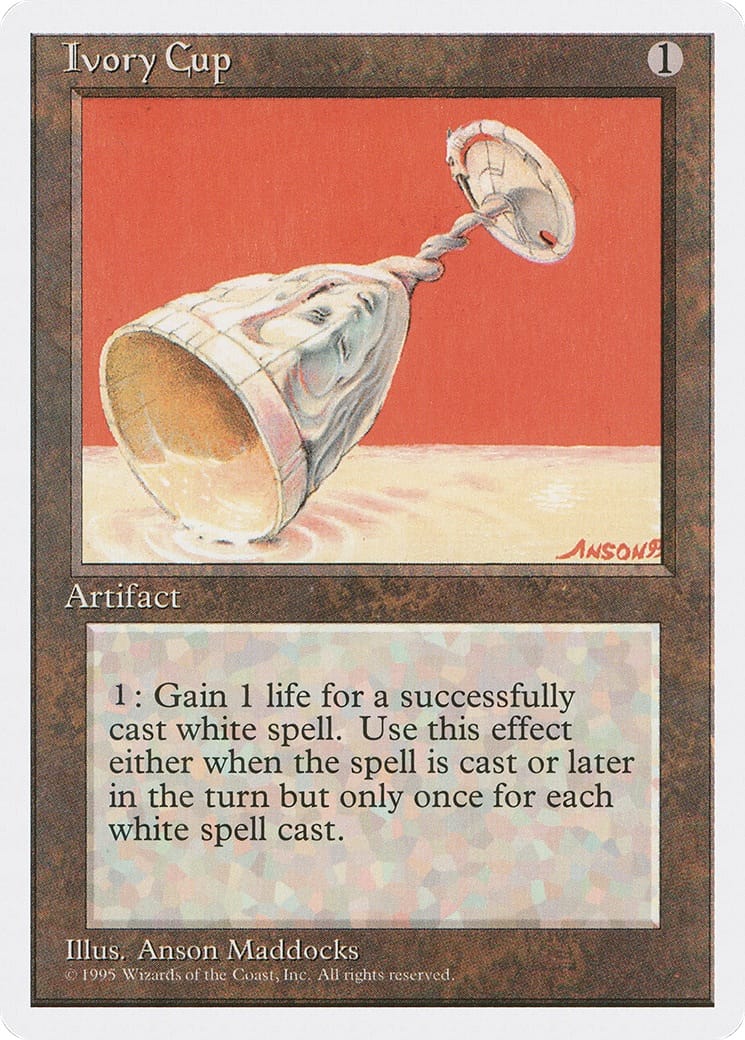
Ivory Cup - MTG 4E


This is the exact same card as Iron Star, except for the color white instead of red. Sometimes Wizards would do a whole cycle of artifacts, one for each color, but at other times they'd only do it for a couple of the colors. I think it all came down to the balance of the game. Did Color X "need" a lifegain artifact to help it out? Well, too bad, because that would make Color X too powerful. Ahhhh, those were the days when Wizards actually cared about the game as a game and not only as a money making machine.

Of course, I "might" be viewing things through my Glasses of Urza nostalgia ;-)


Sunday, November 09, 2025

By Mine Own Right Arm...


I looked, but there was no one to help;
    I was appalled, but there was no one to uphold;
so my own arm brought me salvation,
    and my wrath upheld me.
`Book of Bookstooge, Chapter 63, Verse 5

Thankfully, anyone who suffers from Eggnog Withdrawal Syndrome (or EWS) during the year gets a reprieve now. Eggnog flows like, well, eggnog. While it may look mighty, that container is already 3/4's empty and I'm adding eggnog to the grocery list again. I suffer enough without having to deal with EWS unnecessarily. So cheers to all my fellow EWS sufferers, this is the season we can rest, relax and imbibe!


ps,
In all fairness, Mrs B bought me that eggnog from the grocery store. I don't want any of you thinking that I chopped down a tree, created the cardboard carton, created the eggnog by magic and put them together. Even I am not THAT egotistical. 

Friday, November 07, 2025

The Resolve of Immortal Flesh (Collision #1) 2Stars DNF@45%


This review is written with a GPL 4.0 license and the rights contained therein shall supersede all TOS by any and all websites in regards to copying and sharing without proper authorization and permissions. Crossposted at WordPress & Blogspot by Bookstooge’s Exalted Permission

Title: The Resolve of Immortal Flesh
Series: Collision #1
Author: Rich Colburn
Rating: 2 of 5 Stars DNF@45%
Genre: Thriller
Pages: 543 / 242
Words: 212K / 95K
Publish: 2016


I really tried to give this book the benefit of the doubt, mainly because it had been recommended to me in the Book Recommendations V post. However, the guy who wrote this made that impossible. He’s a bad writer with a terrible sense of pacing, an ego that demands he blather on and on about his pet philosophy and the lack of ability to write realistic characters that are more than cardboard.

This should have been a 300 page book, tops. But we spend an inordinate amount of time following the main character as he grows up in a broken home with insane parents. Things randomly happen with no apparent connection. The main character is also an asshole. I’d have gladly chopped his self-centered head off with my Tool of the Trade.

This is bad writing by a bad writer and I’m glad to see that he hasn’t churned out any more trash after 2017 when he put out the sequel to this book. Harsh, yes, but writers like this guy are polluting the literary landscapes like microplastics are polluting our water supply. They should be ashamed of putting out such sub-par garbage. They aren’t skilled enough and they are also teaching a whole generation of readers to accept writing that isn’t good. I’m going to stop there before I start talking about their “special” place in the afterlife :-(

★★☆☆☆


From the writer

What if the spirit world was rampant with technology sophisticated beyond anything mankind
has imagined?
What if a sociopath got his hands on a powerful piece of this technology?
What if you couldn’t die no matter how much damage your body sustained?
Join a reluctant hero on his quest to discover what the heck he should do with his time now that he has unlimited power and the world as he knew it collides with the “unseen” world. Will demon-possessed biomechanical monsters kill everyone? Will there be enough coffee to last through to the end of the world? Will that play into our hero’s decision whether or not to bother saving it? These are questions we’ve all wondered about. Explore these and other important philosophical questions as you follow the adventure that was contrived to do just that.

On a more serous note:
The Collision series offers a technological explanation for the supernatural. Human psychology, questions of life and death, and the nature of the supernatural play a critical role in the story of a man who becomes aware of the technology used by beings existing in higher modes of reality. The story is filled with humorous situations and comments, fantasy machines, and philosophical discussion.
The target audience is young adult to adult. The book does include some supernatural horror and some violence.


Thursday, November 06, 2025

Best of Mystery 3.5Stars


This review is written with a GPL 4.0 license and the rights contained therein shall supersede all TOS by any and all websites in regards to copying and sharing without proper authorization and permissions. Crossposted at WordPress & Blogspot by Bookstooge’s Exalted Permission

Title: Best of Mystery
Series: ----------
Editor: Alfred Hitchcock
Rating: 3.5 of 5 Stars
Genre: Crime Fiction
Pages: 745
Words: 304K
Publish: 1976


When I started this book of short stories, my intention was to take some notes, as I had kind of, sort of, maybe’ish glanced at the page numbers and my brain registered that this wasn’t one of the normal 200-250 page collections. However, I was using this as a buffer to get through both Skitarius and Tech-Priest (of which not even this book could save Tech-Priest). That didn’t lend itself well to taking notes, so I figured I would just do that after I ended up dnf’ing Tech-Priest.

The problem then became that this beast of a book became a crashing avalanche of stories that I dared not stop lest I become crushed under its ponderous weight. There are 63 stories in this volume. That is just too much. If I had stopped to take notes on even ten of these stories, I probably would have dnf’d this collection just out of despair at so much crime and evil being portrayed. So to continue with the avalanche imagery, I had to keep racing down the literary mountain trying to stay one story ahead. I managed it and I was ok, but I don’t think I’ll try to read another Hitchcock collection that is this big again in the future (not that I have any, mind you. I just looked and the next biggest one is just a shade over 400pages, which I think I can handle). The last time I read a collection this big was Tales of Terror, which had 58 stories.

I guess I’m going to chalk this up to a lesson learned, again. Hahahahaa.

★★★✬☆


Table of Contents:

WINTER RUN—Edward D. Hoch

YOU CANT BLAME ME—Henry Slesar

A FLOWER IN HER HAIR—Pauline C. Smith

THE COST OF KENT CASTWELL—Avram Davidson

PSEUDO IDENTITY—Lawrence Block

THAT RUSSIAN!—Jack Ritchie

GALTON AND THE YELLING BOYS—Hillary Waugh

BLIND DATE—Charles Boeckman

PRESSURE—Roderick Wilkinson

THE RUNNING MAN—Bill Pronzini

THE VIETNAM CIRCLE—F. J. Kelly

SADIE WHEN SHE DIED—Ed McBain

A VERY CAUTIOUS BOY—Gilbert Ralston

A TRY FOR THE BIG PRIZE—Borden Deal

VOICE IN THE NIGHT—Robert Colby

UNDERTAKER, PLEASE DRIVE SLOW—Ron Goulart

NEVER SHAKE A FAMILY TREE—Donald E. Westlake

HERE LIES ANOTHER BLACKMAILER—Bill Pronzini

DEAD DUCK—Lawrence Treat

GAMES FOR ADULTS—John Lutz

NIGHT OF THE TWISTERS—James Michael Ullman

VARIATIONS ON A GAME—Patricia Highsmith

CHILD’S PLAY—William Link and Richard Levinson

JUST A LITTLE IMPRACTICAL JOKE—Richard Stark

MURDERER #2—Jean Potts

THE THIRD CALL—Jack Ritchie

DAMON AND PYTHIAS AND DELILAH BROWN—Rufus King

GLORY HUNTER—Richard M. Ellis

LINDA IS GONE—Pauline C. Smith

FRIGHTENED LADY—C. B. Gilford

COME BACK, COME BACK . . .—Donald E. Westlake

ONCE UPON A BANK FLOOR—James Holding

WARRIOR’S FAREWELL—Edward D. Hoch

DEATH BY MISADVENTURE—Wenzell Brown

WITH A SMILE FOR THE ENDING—Lawrence Block

TELEVISION COUNTRY—Charlotte Edwards

ART FOR MONEY’S SAKE—Dan J. Marlowe

NOTHING BUT HUMAN NATURE—Hillary Waugh

MURDER, 1990—C. B. Gilford

PANTHER, PANTHER IN THE NIGHT—Paul W. Fairman

PERFECTLY TIMED PLOT—E. X. Ferrars

#8—Jack Ritchie

ALL THE NEEDLESS KILLING—Bryce Walton

A MELEE OF DIAMONDS—Edward D. Hoch

ONE FOR THE CROW—Mary Barrett

HAPPINESS BEFORE DEATH—Henry Slesar

I DON’T UNDERSTAND IT—Bill Pronzini

NEWS FROM NOWHERE—Ron Goulart

A CASE OF DESPERATION—Kate Wilhelm

AN INTERLUDE FOR MURDER—Paul Tabori

DEATH OVERDUE—Eleanor Daly Boylan

THE BEST-FRIEND MURDER—Donald E. Westlake

PATTERN OF GUILT—Helen Nielsen

A REAL, LIVE MURDERER—Donald Honig

DOCTOR APOLLO—Bryce Walton

THE PURSUER—Holly Roth

FINAL ARRANGEMENTS—Lawrence Page

COUNTDOWN—David Ely

MURDER BETWEEN FRIENDS—Nedra Tyre

CASE OF THE KIND WAITRESS—Henry Slesar

GHOST OF A CHANCE—Carroll Mayers

THE MONTEVIDEO SQUEEZE—James Holding

THE WHITE MOTH—Margaret Chenoweth


Banquets of the Black Widowers (The Black Widowers #4) 3Stars

  This review is written with a GPL 4.0 license and the rights contained therein shall supersede all TOS by any and all websites in regards...