This
review is written with a GPL 4.0 license and the rights contained
therein shall supersede all TOS by any and all websites in regards to
copying and sharing without proper authorization and permissions.
Crossposted at WordPress & Blogspot by Bookstooge’s Exalted
Permission
Title:
Dune
Series: Dune Chronicles #1
Author:
Frank Herbert
Rating: 5 of 5 Stars
Genre:
SF
Pages: 604
Words:
206K
Publish: 1965
Technically,
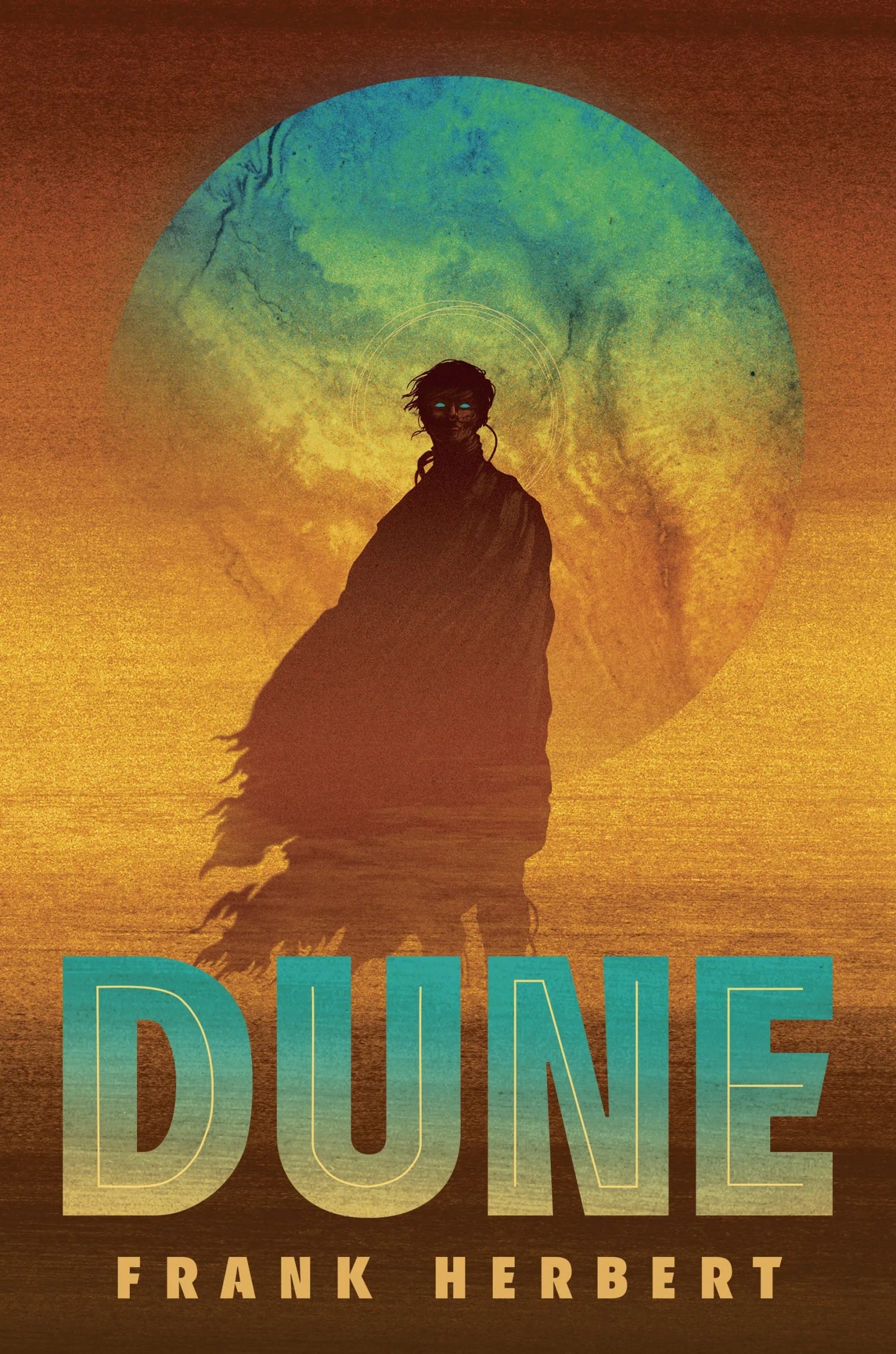
this is the Deluxe Edition released in 2019. I did a “Book
Catch” post when I received it for Christmas the year after it
was released. The reasons it is “deluxe” is because it has new
(delicious!) cover art, some maps and stuff and then some blatherings
by Herbert’s son Brian. Brian has blathered on in other previous
editions of Dune, mainly because he’s not man enough to
write something successful like Dune so he’s getting by on
daddy’s coat tails. In the older editions, Brian did an
“Afterwards” where he self-promoted the new Dune stuff he and
that no-good lousy pathetic Kevin J Anderson co-wrote along with
teasing about Dune 7, the mythical book Frank was going to write to
finish up the Dune Chronicles, but died before that happened.
Baby Herbert and KJ(ack)A(ss) wrote Hunters
of Dune and Sandworms
of Dune and both sucked donkieballz. I compared this “new”
Forward to that older Afterwards and the only difference is that Baby
Herbert adds a paragraph talking about the upcoming new Dune movies
(Dune:
Part I and Dune:
Part II) as well as various games coming (Dune
Imperium I believe, which Spalanz has talked about extensively)
out soon. What a fething loser, can’t even write a new Foreward,
how pathetic is that?
And
enough of that! Onward to the good stuff.
This
is my fourth “Official” read through of Dune. Down
at the end of the review, under my avatar, you’ll see links to the
previous three reviews. However, like many of my favorite books here
on my blog, I read and re-read this book many times before I started
recording my reviews. I think I was 14 or 15 when I first read Dune.
I saw a paperback at the library and it had the atrocious movie cover
of the 1984 movie, but to teenager me, it looked awesome (and while I
abominate that movie as a “Dune” movie, I like it well enough on
its own) and when I read it, the scope just blew me away. Then when I
was a bit older I found out the library had the rest of the Dune
Chronicles in hardcover and I devoured them, even while not
necessarily understanding all that was going on. But based on my
reading habits as a teen, I suspect I read Dune three
times between 1993 and 2000, which is when I began recording when I
read books. So this is probably my 7th
time reading it, possibly my 8th
and I still love it and
think it is a complete and utter 5star book. It doesn’t get much
better than this.
This
is not an action book. There is the fight scene between Paul and
Jamis when Paul and his mother are escaping to the desert and the
dubious safety of the Fremen, but it is no more than a couple of
paragraphs. There is also the fight scene near the end of the book
between Paul and his cousin Feyd-Rautha Harkonnon but once again,
only a couple of paragraphs long. Any of the battle scenes between
the Fremen and smugglers or the Sardakaur are only given the broad
brushstroke treatment. If you read much of Herbert, you will come to
discover that he doesn’t like action scenes. He prefers things to
happen off page and then just state that they happened. That
proclivity isn’t as apparent here, but the roots of that mindset
are shown for those who are looking. I’ve noted that before, but I
think it bears proclaiming because of how the damnable new movies
show the stories. There is lots of action shown in those that are
simply glossed over in the book. Dune is
not a simple adventure story.
I
hesitate to say the following, and I’ll explain why after. Dune
is a thinking man’s story. I
don’t like saying that because it smacks of literary snobbery and
the kind of people who think absolute garbage writing is the best. I
despise literary types, who wouldn’t know a good story if it
grabbed them by the throat and choked them to death. To them, the
story is the least important part of a book. A “good” book is one
that either preaches what they are preaching, or is one that they can
shoehorn in their own despicable baby killing world view and try to
destroy everything good and decent. They are the kind of people who
read a book and then try to tell everyone “what it really means”
no matter what is patently obvious or even stated by the author
himself. They are the militant vegetarians of the book world. But
vegetarians have some very good points to make when it comes to
health and it would behoove most Americans to listen to them more.
And thus it is with Frank Herbert and Dune. The
story is a good story AND Herbert brings up many different aspects of
humanity and sets forth his thoughts on the issues. It’s not that
he’s baldly pontificating and denigrating everyone who disagrees
with him, but he’s putting forth ideas and letting the reader
decide how deep they want to follow that rabbit trail he has exposed
to their view. Herbert won’t be put into just one box.
He
doesn’t do this through just one avenue of thought, but through a
multiplicity of story ideas. You have the government of the Landsraad
and the Imperial House. You have the Bene Gesserit and their breeding
program for the next step of human evolution. You have the Fremen and
the Sardakaur as objects of war, both secular and religious. You have
prophetic visions on one hand and manipulations of the space/time
continuum on the other in the Spacing Guild. Paul himself brings most
of these ideas into himself and we are given little hints that he is
cogitating some very deep things, things which Herbert doesn’t
write about in this book.
Each
time I read Dune I
have to decide if I’ll continue the Chronicles or treat it as a
standalone. It really changes how you view this book depending on
which option you go with. When I last read this in 2017, I stated
that I wanted to read Dune as
a standalone from then on. I can understand why I wrote that. It is
very hard to start reading the Chronicles and not finish, as the
story keeps pulling you deeper and deeper into the mythos. The
problem is that it leads you into the horrendous finale by Frank’s
son (the aforementioned Dune 7 duology linked in the first paragraph
above) and nothing is worth that, absolutely nothing. Now, Frank did
write a trilogy for Dune. Dune,
Dune Messiah and then
Children of Dune. God
Emperor of Dune is a pivot point
in the series and heads the reader off into a much broader scope of a
story, for good or ill is up to you to decide. This time around I’m
thinking I’ll read the trilogy, as I’ve never done that before.
This
book is over 600 pages, but that is because there is a glossary and
several appendixes. I HIGHLY recommend reading those and not skipping
them. In fact, you might want to keep your finger in the glossary
section so you can look up terms, names and places when you come
across them in the story and don’t understand them. Do be aware, if
you do that, there will be spoilers. Reading these is a good
refresher course for any Dune lover and whether this is your first
time or your eighth, you can’t go wrong with reading the them.
Finally,
the cover to the Deluxe Edition. I love it, period. I can already
tell this is going to be the cover love choice for December. It is as
inevitable as Paul Muad’dib’s jihad ;-)
★★★★★
From
Wikipedia
Duke Leto
Atreides of House Atreides, ruler of the ocean
world Caladan, is assigned by the Padishah Emperor Shaddam
IV to serve as fief ruler of the planet Arrakis. Although
Arrakis is a harsh and inhospitable desert planet, it is of
enormous importance because it is the only planetary source
of melange, or the "spice", a unique and incredibly
valuable substance that extends human youth, vitality and lifespan.
It is also through the consumption of spice that Spacing
Guild Navigators are able to effect safe interstellar travel
through a limited ability to see into the future. The Emperor is
jealous of the Duke's rising popularity in the Landsraad, the
council of Great Houses, and sees House Atreides as a potential rival
and threat. He conspires with House Harkonnen, the former
stewards of Arrakis and the longstanding enemies of the Atreides, to
destroy Leto and his family after their arrival. Leto is aware his
assignment is a trap of some kind, but is compelled to obey the
Emperor's orders anyway.
Leto's concubine Lady
Jessica is an acolyte of the Bene Gesserit, an
exclusively female group that pursues mysterious political aims and
wields seemingly superhuman physical and mental abilities,
such as the ability to control their bodies down to the cellular
level, and also decide the sex of their children. Though Jessica was
instructed by the Bene Gesserit to bear a daughter as part of
their breeding program, out of love for Leto she bore him a
son, Paul. From a young age, Paul is trained in warfare by
Leto's aides, the elite soldiers Duncan Idaho and Gurney
Halleck. Thufir Hawat, the Duke's Mentat (human
computers, able to store vast amounts of data and perform advanced
calculations on demand), has instructed Paul in the ways of political
intrigue. Jessica has also trained her son in Bene Gesserit
disciplines.
Paul's prophetic dreams
interest Jessica's superior, the Reverend Mother Gaius
Helen Mohiam. She subjects Paul to a deadly test. She holds a
poisoned needle, the gom jabbar, to his neck, ready to strike
should he withdraw his hand from a box which creates extreme pain by
nerve induction but causes no physical damage. This is to test Paul's
ability to endure the pain and override his animal instincts, proving
that he is, in Bene Gesserit eyes, human. Paul passes, enduring
greater pain than any woman has ever been subjected to in the test.
Paul
and his parents travel with their household to occupy Arrakeen,
the capital on Arrakis. Leto learns of the dangers involved in
harvesting the spice, which is protected by giant sandworms, and
seeks to negotiate with the planet's indigenous Fremen people,
seeing them as a valuable ally rather than foes. Soon after the
Atreides' arrival, Harkonnen forces attack, joined by the Emperor's
ferocious Sardaukar troops in disguise. Leto is betrayed by
his personal physician, the Suk doctor Wellington Yueh, who
delivers a drugged Leto to the Baron Vladimir Harkonnen and
his twisted Mentat, Piter De Vries.
Yueh,
who delivered Leto under duress, arranges for Jessica and Paul to
escape into the desert. Duncan is killed helping them flee, and they
are subsequently presumed dead in a sandstorm by the Harkonnens. Yueh
replaces one of Leto's teeth with a poison gas capsule, hoping Leto
can kill Baron Harkonnen during their encounter. Piter kills Yueh,
and the Baron narrowly avoids the gas (due to his defensive shield),
which kills Leto, Piter, and the others in the room. The Baron forces
Thufir to take over Piter's position by dosing him with a
long-lasting, fatal poison and threatening to withhold the regular
antidote doses. While he follows the Baron's orders, Thufir works
secretly to undermine the Harkonnens.
Having
fled into the desert, Paul is exposed to high concentrations of spice
and has visions through which he realizes he has significant powers
(as a result of the Bene Gesserit breeding scheme). He foresees
potential futures in which he lives among the Fremen before leading
them on a holy war across the known universe. Paul reveals
that Jessica's father is Baron Harkonnen, a secret kept from her by
the Bene Gesserit.
Paul
and Jessica traverse the desert in search of Fremen people. After
being captured by a Fremen band, Paul and Jessica agree to teach the
Fremen the Bene Gesserit fighting technique known to the Fremen as
the "weirding way" and are accepted into the community
of Sietch Tabr. Paul proves his manhood by killing a Fremen man
named Jamis in a ritualistic crysknife fight and chooses
the Fremen name Muad'Dib, while Jessica opts to undergo a ritual to
become a Reverend Mother by drinking and neutralizing the
poisonous Water of Life. Pregnant with Leto's daughter, she
inadvertently causes her unborn daughter Alia to become
infused with the same powers in the womb. Paul takes a Fremen
lover, Chani, who bears him a son he names Leto.
Two
years pass, and Paul's powerful prescience manifests, which confirms
to the Fremen that he is their prophesied "Lisan
al-Gaib" messiah, a legend planted by the Bene
Gesserit's Missionaria Protectiva. Paul embraces his father's
belief that the Fremen could be a powerful fighting force to take
back Arrakis, but also sees that if he does not control them,
their jihad could consume the entire universe. Word of the
new Fremen leader reaches both the Baron and the Emperor as spice
production falls due to their increasingly destructive raids. The
Baron encourages his brutish nephew Glossu "Beast"
Rabban to rule with an iron fist, hoping the contrast with his
shrewder nephew Feyd-Rautha will make the latter popular
among the people of Arrakis when he eventually replaces Rabban. The
Emperor, suspecting the Baron of trying to create troops more
powerful than the Sardaukar to seize power, sends spies to Arrakis.
Thufir uses the opportunity to sow seeds of doubt in the Baron about
the Emperor's true plans, putting further strain on their alliance.
Gurney,
who survived the Harkonnen coup and became a smuggler, reunites with
Paul and Jessica after a Fremen raid on his harvester. Believing
Jessica to be a traitor, Gurney threatens to kill her but is stopped
by Paul. Paul did not foresee Gurney's attack and concludes he must
increase his prescience by drinking the Water of Life, which is fatal
to males. Paul falls into unconsciousness for three weeks after
drinking the poison, but when he wakes, he has clairvoyance across
time and space: he is the Kwisatz Haderach, the
ultimate goal of the Bene Gesserit breeding program.
Paul
senses the Emperor and the Baron are amassing fleets around Arrakis
to quell the Fremen rebellion, and prepares the Fremen for a major
offensive. The Emperor arrives with the Baron on Arrakis. The
Sardaukar seize a Fremen outpost, killing many, including young Leto,
while Alia is captured and taken to the Emperor. Under cover of an
electric storm, which shorts out the Sardaukar's defensive shields,
Paul and the Fremen, riding giant sandworms, destroy the capital's
natural rock fortifications with atomics and attack, while
Alia assassinates the Baron and escapes. The Fremen quickly defeat
both the Harkonnen and Sardaukar troops, killing Rabban in the
process. Thufir is ordered to assassinate Paul, who gives him the
opportunity to take anything that Thufir wishes of him. Thufir
chooses to stab himself with the poisoned needle intended for Paul.
Paul
faces the Emperor, threatening to destroy spice production forever
unless Shaddam abdicates the throne. Feyd-Rautha challenges Paul to a
knife fight, during which he cheats and tries to kill Paul with a
poison spur in his belt. Paul gains the upper hand and kills him. The
Emperor reluctantly cedes the throne to Paul and promises his
daughter Princess Irulan's hand in marriage. Paul takes control
of the Empire, but realizes that he cannot stop the Fremen jihad, as
their belief in him is too powerful to restrain.