Thursday, December 11, 2025

Banquets of the Black Widowers (The Black Widowers #4) 3Stars


This review is written with a GPL 4.0 license and the rights contained therein shall supersede all TOS by any and all websites in regards to copying and sharing without proper authorization and permissions. Crossposted at WordPress & Blogspot by Bookstooge’s Exalted Permission

Title: Banquets of the Black Widowers
Series: The Black Widowers #4
Authors: Isaac Asimov
Rating: 3 of 5 Stars
Genre: Mystery
Pages: 153
Words: 72K
Publish: 1984


Asimov shakes things up, just a little, by having the club members either break rules or do something completely out of the ordinary here. Not for every story, but enough. It would be like if Rex Stout had his character Nero Wolfe actually leave his house (which while Wolfe states that he won’t leave his house, his actions give the lie to that more often than not, sigh). It shook things up as the routine was broken and that was a good thing. The bickering and outright fighting amongst the members is really getting on my nerves. I’ve got one more book of these to read and then I’ll have finished the series.

I think my favorite story this time around was “The Driver” about a bunch of egghead scientists and a SETI convention and some low IQ driver getting killed. Turns out the driver was pretending and he was a Soviet spy and he let slip one bit of info that would have given him away, so his Soviet Masters had him done away with. It might have been a Cold War, but nobody was phutzing around, that was for sure.

Several of the other stories all revolve around human nature, as Asimov perceived it. I don’t see eye to eye with him on that issue all the time so those stories fell really flat for me. They also irritated me because they involved people being really stupid and even when I think that people ARE stupid, doesn’t mean I want to read about it. I mean, you like being healthy right? So do you want to read stories about weeping, suppurating boils and sores, oozing pus? Yeah, me neither.

★★★☆☆


From Wikipedia.org

"Introduction"

  • "Sixty Million Trillion Combinations" (Ellery Queen's Mystery Magazine, 5 May 1980) – A paranoid mathematician who suspects that his work on Goldbach's conjecture has been stolen. When the authorities demand his cooperation, he sulkily gives a clue to the code which protects his work on a shared computer, suspecting that no one could possibly guess or deduce the code. Fortunately for the agencies who need this information, the Black Widowers are able to come up with the code, purely because one member shares a trait with the mathematician.

  • "The Woman in the Bar" (Ellery Queen's Mystery Magazine, 30 June 1980) – the Black Widowers have as their dinner guest Darius Just, the main character from Asimov's mystery novel Murder at the ABA. Darius finds himself in danger of violent reprisals when he tries to help a frightened woman (he knows she is frightened, but he can have no idea by whom or why). She has given him crucial nonverbal communication clues which the Black Widowers solve. Asimov states that he "thought up" this Black Widowers story just for this character.[4]

  • "The Driver" – the Black Widowers consider the mysterious death of a chauffeur at a SETI Institute conference.

  • "The Good Samaritan" (Ellery Queen's Mystery Magazine, 10 September 1980) – in a controversial break with tradition, a woman is invited to attend the men-only club.

  • "The Year of the Action" (Ellery Queen's Mystery Magazine, 1 January 1981) – a historical clue is solved about a comic opera, "The Pirates of Penzance," by Gilbert and Sullivan.

  • "Can You Prove It?" (Ellery Queen's Mystery Magazine, 17 June 1981) – the guest describes his arrest and interrogation behind the Iron Curtain and is unable to explain why he was released.

  • "The Phoenician Bauble" (Ellery Queen's Mystery Magazine, May 1982) – a valuable archaeological artefact has been lost.

  • "A Monday in April" (Ellery Queen's Mystery Magazine, May 1983) – concerns a matter of trivia about ancient Rome. The evenings guest feels that his girlfriend cheated in a competition, but Henry's solution casts doubt on that presumption.

  • "Neither Brute Nor Human" (Ellery Queen's Mystery Magazine, April 1984) – the story requires solving a riddle about a poem by Edgar Allan Poe.

  • "The Redhead" (Ellery Queen's Mystery Magazine, October 1984) – a woman disappears into thin air.

  • "The Wrong House" – the guest is unable to determine which of his neighbours has been counterfeiting money after witnessing their operation while drunk.

  • "The Intrusion" – an uninvited guest crashes the party and asks the Black Widowers for help in finding the man who took advantage of his developmentally challenged sister.


Wednesday, December 10, 2025

Jane Austen: Evelyn 3Stars


This review is written with a GPL 4.0 license and the rights contained therein shall supersede all TOS by any and all websites in regards to copying and sharing without proper authorization and permissions. Crossposted at WordPress & Blogspot by Bookstooge’s Exalted Permission

Title: Evelyn
Series: ----------
Author: Jane Austen
Rating: 3 of 5 Stars
Genre: Satire
Pages: 32
Words: 10K
Publish: 1792


This was an over the top satire about the amiability of the English. It also satirizes most of the other subjects that Austen touches on as an adult in her later novels. The power of love, and people dying from it. The power of family, and people ignoring theirs.

The title is taken from the town that the main character lives in. Evelyn is not a woman, despite what the cover I have used here tries to make you think. I suspect someone saw the title, thought “Aha, a woman’s name” and slapped a woman on a background and tried to sell this on Amazon or Kobo or something. That’s the danger of not doing your research. On that note, in the state of Pennsylvania, there is a town called Intercourse. Right next to it is another town called Peach Bottom. Imagine what the cover to those (imaginary) books would look like! Certainly wouldn’t be Jane Austen approved.

When I read the previous juvenilia story by Austen (Catharine) I wondered if I could keep on going with these juvenilia shorts. Evelyn has shown me that I can. I simply have to frame my reading in the appropriate context, ie, Austen was a child or teenager when she wrote these for her family and are not meant to be judged as her novels are, being publicly and intentionally released.

★★★☆☆


From CourseHero.com

The story's title is the name of a tranquil, idyllic town that exists without illness or unhappiness. A man named Mr. Gower is passing through the town and falls in love with it. He decides he must find a house in town for himself. He stops at a small inn to ask about any available houses. He learns that there are no available houses because so many people love the town of Evelyn. Mr. Gower is approached by Mrs. Willis before he can despair and she tells him about a possible house for him. Mr. Gower quickly travels to this house to meet the owners Mr. Webb and Mrs. Webb. Mr. Gower meets Mrs. Webb who is incredibly generous and provides a feast and a generous sum of money to Mr. Gower immediately upon his arrival. Mr. Webb enters and asks Mr. Gower what else they can do. Mr. Gower asks for their house and grounds which both Webbs agree to without question. The Webbs introduce their daughters as they prepare to leave. Mr. Gower falls in love with the oldest Webb daughter Maria Webb and they are married the next day.

The couple is incredibly happy for several months until Mr. Gower is reminded of his sister. Mr. Gower's sister Rose fell in love with a high-ranking man named Henry but Henry's father did not approve of the match. Henry was forced to travel to the Isle of Wight by ship before the couple could marry. The ship was wrecked and Henry died. Rose is so overcome with this loss that Mr. Gower wants to do something to ease her pain. Mr. Gower decides to go to Henry's father and ask for a portrait of Henry for Rose. Unfortunately Mr. Gower gets distracted by the beauty and peace of Evelyn before completing his mission. Mr. Gower feels he must complete his mission but first sends a letter home to make sure his sister is still alive. The letter Mr. Gower receives in response tells him that Rose died six weeks earlier. Mr. Gower is overwhelmed by the loss but sets off to learn whether Henry's father would approve of the match if the two lovers were still alive. Henry's father states that he would not. Mr. Gower returns home to find that Maria died a few hours after he left. Mr. Gower is upset, makes arrangements for her funeral, and returns to his family home to be comforted.

Mr. Gower enters his family home and he sees his sister Rose sitting on the couch. He learns that Rose lied about her death to make Henry's family feel bad. She actually learned of Henry's death only a few days earlier when she met Mr. Davenport. Mr. Davenport brought the news of Henry's death and proposed to Rose on the spot. She accepted and the couple was married. Mr. Gower is shocked but congratulates the happy couple and walks to a local inn for a drink. At the inn Mr. Gower meets Mrs. Willis again and immediately asks for her hand in marriage. She agrees and the couple returns to Evelyn. Mr. Gower writes a letter after the couple arrives back home explaining the death of Maria to Mr. and Mrs. Webb. The Webbs' response is short and appreciative and does not show any sign of grief or sadness.


Tuesday, December 09, 2025

Trio for Blunt Instruments (Nero Wolfe #39) 4Stars


This review is written with a GPL 4.0 license and the rights contained therein shall supersede all TOS by any and all websites in regards to copying and sharing without proper authorization and permissions. Crossposted at WordPress & Blogspot by Bookstooge’s Exalted Permission

Title: Trio for Blunt Instruments
Series: Nero Wolfe #39
Author: Rex Stout
Rating: 4 of 5 Stars
Genre: Mystery
Pages: 198
Words: 72K
Publish: 1964


This was an enjoyable trio of novellas about Archie and Wolfe getting involved with “dames” and solving the various mysteries. I have to admit, I am not such a fan of these collections of novellas versus the full novels. Next time I go through the Wolfe series, I plan on reading each novella on its own and reviewing just it.

This was published in 1964 and the first Wolfe novel, Fer De Lance, was published in 1934. You can tell the difference in the culture that each book was written in. It is kind of shocking to see the changes in just 30 years. But then I realize what 30 years has done in my life time, so I really shouldn’t be surprised.

★★★★☆


From Wikipedia

Kill Now—Pay Later

Wolfe's aging Greek bootblack is accused of murder and Wolfe feels he owes him something since he (apparently) listens eagerly to Wolfe's dissertations on ancient Greek culture during every shoe-shining session and moreover has told the police that "Wolfe is a great man"


Murder Is Corny

The story, apart from its crime detection aspects, is a story about how a simple, very beautiful, country girl comes to the big city, enters the world of high fashion, but cannot escape the risqué side of big city life. Nor is the country life in Putnam County devoid of moral failings, and they both play a part in the final resolution of this story.


Blood Will Tell

Archie is sorting through the mail one Tuesday morning when an unusual envelope catches his attention. Bearing the return address of composer James Neville Vance, the envelope contains a bloodstained tie and a note for Archie to keep it until Vance makes contact with him. After receiving a call claiming to be from Vance instructing him to destroy the envelope and contents, Archie heads to Vance's apartment to investigate.

Vance denies any knowledge about the envelope, though he admits the tie is one of nine he owns, designed uniquely for him, adding that one is missing and another was gifted to a friend. When the janitor and a patrol officer come to ask Vance for access to the apartment belonging to Bonny & Martin Kirk, Archie joins them; together, they discover Bonny's corpse, head smashed in with a vodka bottle.

The next day, a disheveled Martin Kirk comes to the brownstone to hire Wolfe, who immediately takes him on as a client. Kirk reveals that Vance gifted him one of his neckties two months ago and that Bonny was a serial adulterer, with one of her lovers being another neighbor, Paul Fougere. During the conversation, Paul's wife Rita arrives, having followed Kirk. Wolfe sends Kirk home to look for the necktie and speaks with Rita, who reveals that she knew about the affair and that she is in love with Kirk.

Kirk calls and informs them that the necktie is missing; he and Rita decide to visit Vance to ask him about the envelope. The meeting turns bloody when Paul shows up unannounced, and Kirk accuses Paul of killing Bonny out of jealousy. After the fight subsides, Sergeant Stebbins arrives to take Kirk in for questioning.

Wolfe asks Archie to use the threat of a defamation lawsuit in order to bring Paul in, and the Fougeres do come to the brownstone four hours later. They find out from Paul that Vance has also been pining for Bonny.

As the conversation ends, Archie and Wolfe independently determine the identity of the culprit. When Inspector Cramer arrives, Wolfe lets him in on their deductions, asking him to hold the culprit for question and sending Archie, Saul, Fred, and Orrie to search that person's residence. While there, they find not only the clue that confirms their deductions but also a grisly trophy of the crime.


Monday, December 08, 2025

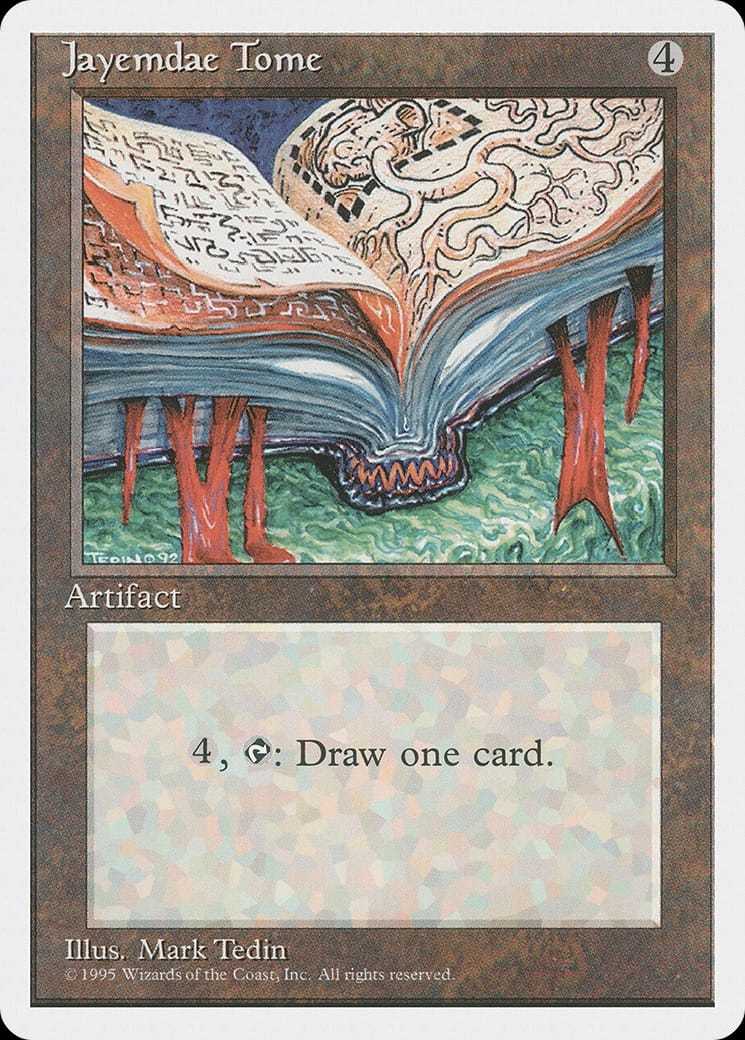
Jayemdae Tome - MTG 4E


I loved this card back in the day. I always liked artifacts (no clue why, they just were cool) and having card draw was important for the game. The problem is, this card is extremely mana intensive. So unless your deck was built around getting a lot of land out quick (land is what you use to get mana and you can normally only put one land on the table each turn), you were spending all your available mana to draw more cards, that you then had no mana to use. Another card that I just couldn't make work for me. Honestly, I don't think it was supposed to work. Wizards would put in semi-bad cards just to fill up the card slots.

On an unrelated note. When I was looking around to upgrading my avatar from the old

to some sort of actual picture, I did consider using the artwork from this card. I really liked that old looking book. But I liked a "person" kind of avatar more, so I went with this guy

and that has eventually led me to my current avatar. See, books are an adventure!


Sunday, December 07, 2025

When a Daddy Eggnog Loves a....


...Mommy Frappuccino very, Very, VERY much, something magical happens.

Vikings from Newfoundland put a little Mocha Frappueggnogccino into a mug and deliver it and in just a few moments, a new delicious drink is born.

And immediately after that, the Big Bad Bookstooge comes along and drinks them all down, lock, stock and barrel!  


Friday, December 05, 2025

A Rainbow to Heaven Chapters 1-3 (1.5Star DNF@21%)


This review is written with a GPL 4.0 license and the rights contained therein shall supersede all TOS by any and all websites in regards to copying and sharing without proper authorization and permissions. Crossposted at WordPress & Blogspot by Bookstooge’s Exalted Permission

Title: A Rainbow to Heaven DNF@21%
Series: -----
Author: Barbara Cartland
Rating: 1.5 of 5 Stars
Genre: Romance
Pages: 134 / 28
Words: 52K / 11K
Publish: 1934


Chapter 1

We are introduced to our heroine, Diana Headley, as she prepares to go to a party. We learn that she's a thorough socialite but well off and sought after by the newspapers to have her picture taken. At the same time we're reassured she's not a vapid, empty headed numpkin but a woman of taste and talent, albeit one who is fast approaching that line of "tired" that overtakes many in the upperclasses.

We are also introduced to Lord Hugo Dalk, a 37 year old Lord who is independently wealthy and has decided that Diana is the woman for him. They get along well, like a pair of friends and Diana doesn't appear that she wants more than that, as something deep inside doesn't feel that Dalk is the one. Yet Dalk proposes to her in a casual, off hand manner that seems to imply he at least feels they are the only ones worthy of the other.

We also meet the hosts of the party, the Schnibers. They come from new money, as Mr Schniber made his fortune in "hooks and eyes", so I'm guessing women's undergarments? He's not comfortable nor are his wife and daughter, but they so want to be part of the "crowd" that even throwing a society party for complete strangers is not out of bounds.

The contrast between Diana, Hugo and Mr Schniber is well sketched. Diana is a worldly woman but not yet taken over by ennui. Hugo has all the hallmarks of a socialite bored with life itself while Schniber is the prototypical "country bumpkin", wide eyed and convinced all the socialites are better people than he.

Chapter 2

Diana doesn't want to deal with Hugo's proposal. She's very attracted to him but is contrary enough to not want him out of hand. She comes across some old friends, the Standish's and finagles a visit down to their home, thus giving her space and time from Hugo. Hugo is understandably upset but self-centered enough to think Diana will say yes eventually.

The Standish's introduce us to Barry Dunbar, "one of the most brilliant men" the Standish's have ever met as well as being "one of the greatest young intellects in Europe today." He's deep into Eastern mysticism and spends his days seeking out old scrolls to bring them to the eyes of Europe. Barry is convinced that Eastern Mysticism is the key to the spiritual salvation of Europe. We find out that the Standish's have given a part of their home over to Barry and he runs it like a tyrant, ie, his rules, his way. They admire him so much that they give way on everything.

Diana heads down to Standish Castle, still wondering why she hasn't accepted Hugo's proposal. Lots of garbage is thrown around but it amounts to "I just don't want to, so there".

I am not liking Barry from the get-go. Hugo is an arrogant ass, but I understand him. Barry is all second hand introduction and the way the Standishes fawn over him makes me sick. Plus, anyone who thinks that Eastern Mysticism is going to solve any problems is about as empty and shallow as possible. It's a new bauble, that is all and they are entranced by the shininess of it. I despise people like that.

Chapter 3

We start out with a background sketch of how Mrs Standish became Mrs Standish and how fulfilled she is now that she is married to Jack Standish. This gives her "spiritual" weight so her thoughts and pronouncements about and to Diana aren't just the blatherings of a busybody. But they are. Mrs Standish is presented as a "good person" because she tries to help others. This excuses any behavior by her, because "she is a good person". Then we get some more secondhand Barry praise and how deeply spiritual and philosophical he is, thus ALSO making him "a good person".

Diana meets Barry at dinner and is impressed that he's not a society bore and a shallow jackass (my words obviously) like her other acquaintances. Barry "only talks about important things" and this also impresses Diana while at the same time making her feel her inferiority, to which feeling she is not used to. After dinner Barry and Diana have a little one on one talk and Barry makes it quite clear that he considers her and her kind the bane of England and the beginning of the end for England's greatness.


This is a shallow romance and it touches on theology and philosophy, but sadly, in the same trite, pathetic and non-thinking way that it deals with romance. You do not treat theology that way. Theology, whether you like it or not, is what sets the boundaries of your world and defines everything you do for your whole life.

I should not have chosen this book. It was a big mistake considering how high of a regard I hold my theology in. I felt like Cartland spit in my face and then wondered what the big fuss was about. I am dnf'ing this now and this is my review. I sincerely apologize to anyone else who chose to read this and thought there would be several more weeks of lighthearted fun to be had. To expiate my literary sins, I will now commit seppuku, the practice of which people like Barry Dunbar are apparently fully in favor of. So screw that. I’m seppuku’ing Barry Dunbar. That’s him under the motorcycle helmet, not me!


Thursday, December 04, 2025

The Tau Empire (Warhammer 40K: Tau #5) 3Stars


This review is written with a GPL 4.0 license and the rights contained therein shall supersede all TOS by any and all websites in regards to copying and sharing without proper authorization and permissions. Crossposted at WordPress & Blogspot by Bookstooge’s Exalted Permission

Title: The Tau Empire
Series: Warhammer 40K: Tau #5
Author: Braden Campbell
Rating: 3 of 5 Stars
Genre: SF
Pages: 399
Words: 139K
Publish: 2016


Holy smokes, it has been TWO YEARS since I read the novella Farsight. Where does the time go? I bring this up because Farsight is the anchoring novella to this collection of stories centered around the Tau. I did decide to skip reading it again, so that definitely helped me move things along.

One thing I have appreciated about reading the Commander Farsight novels (Farsight, Crisis of Faith, Blade of Damocles, Empire of Lies) is that he is a pretty positive and upbeat character. He really believes in the Greater Good and that he and the Tau can make the universe a better place. That is very unusual in the Warhammer 40,000 literary univerise and to be honest, I kind of took it for granted. Then I read this book and realized I shouldn’t.

Most of the stories here involve other Tau besides Farsight. He is the lead for Farsight and is also featured in Fire and Ice but more as a side character. The other stories deal with other Tau who have orbited Farsight’s sphere of influence in the previously mentioned Tau books. They are much more aligned to the grim darkness of the far future in WH40K. That’s not necessarily a pleasant thing at all.

Peter Fehervari in particular seems to absolutely relish writing stories about death and decay and the collapse of the mind, will and emotions of the characters in his stories. It’s not that everyone dies (as in a Russian story) but that everyone gets broken, very broken, in some manner. It might be their body or their mind or their emotional psyche. After reading these couple of short stories by him, I think I’ll avoid his full novels and collections. I suspect they would be too much for me to handle.

The other two authors, Campbell and Smillie were decent enough but once again, the stories were grim.

I am realizing that much like my foray into Cthulhu’ic Cosmic Horror, I need to limit my reading time in the WH40K universe. I also have to be mindful of which faction I am reading about. I know I enjoy reading about the Necrons (terminator like aliens millions of years old) and to this point, the Tau. What I most enjoy though are the ordinary people in the Empire of Man which I’ve read through the likes of Commissar Gaunt & his Ghosts and Commissar Ciaphus Cain, Hero of the Imperium. I need to seek out some Astra Militarum books (that’s the fancy way of saying the plain old soldiers in WH40K speak) and hope there’s some hope in them :-D I’m not holding out much hope though. Hahahahahahaa.

★★★☆☆


From the Publisher:

It is the manifest destiny of the Tau Empire to rule the stars. Guided by the principle of the Greater Good and driven by the orders of the mysterious ethereals, they conquer worlds, by words or force, and defend them by the might of the fire caste, noble warriors armed with advanced weaponry and powerful battlesuits. 'Shas'o' contains ten tales of the Tau Empire at war, featuring mighty battlesuits battling Imperial tanks, fire warrior snipers duelling with Space Marines and stories of some of the tau's greatest heroes, including Farsight, Shadowsun and Aun'Shi.


ToC:

Farsight – Phil Kelly

Fire and Ice – Peter Fehervari

Aun’Shi – Braden Campbell

A Sanctuary of Wyrms – Peter Fehervari

Commander Shadow – Braden Campbell

Out Caste – Peter Fehervari

Shadowsun: The Last of Kiru’s Line – Braden Campbell

The Patient Hunter – Joe Parrino

The Kauyon – Andy Smillie

The Tau’va – Andy Smillie


The Black Colossus (Conan Chronicles #4) 3.5Stars

  This review is written with a GPL 4.0 license and the rights contained therein shall supersede all TOS by any and all websites in regards...